

THE NEWSLETTER | 04.30.25 | V05N12
Co-Founder/Content: Doug Fodeman | Co-Founder/Creative: David Deutsch | Scambaiter: Rob M

Approved Advertisement


Rampant Facebook Fraud Almost Had a New Victim!
In mid-April we saw a post on the community website Nextdoor.com from a woman who was warning people about apartment scams on Facebook. It turns out that her sister almost fell for this scam. We reached out to the sister and she was happy to share her story with us. It was much more complicated and far more extensive than we anticipated. And, quite surprisingly, it also resulted in this woman’s Facebook account getting hacked and suspended! As you can likely guess, Facebook was extremely unhelpful in both removing the fraud from their community or helping this woman recover her Facebook account. Given the remarkable timing of this woman reporting these apartment rental posts as a fraud and her Facebook account being hacked, we believe the person behind the apartment scam also hacked her account using information she submitted in her rental application. (She shared some details about her former Facebook password with us and, yes, it used some personal information.)
To protect her identity, we’ll call this woman Susan. Susan was interested in an apartment in the Peabody, Massachusetts area starting in early summer. She was part of the Peabody Mass Group on Facebook and would sometimes see apartment rental listings posted to this group. Sometime around April 12, she saw a post to this Group for a 2-bedroom apartment on 1 Aborn Street in Peabody. The post said to text a man named Chris at 321-467-0265 if you were interested, though the post itself was made by someone named Brice Strong on March 26. Susan texted Chris to ask if the apartment was still available. Chris asked her to send him a picture of the specific listing she was interested in. When Susan went back to look for that listing, she found something very odd. There was another post for the 2-bedroom apartment on 1 Aborn Street in Peabody sent by someone named Cent Linda on March 29. This post also told anyone interested in the apartment to text Chris at 321-467-0265. But the photos shown in this March 29 post seemed to be for a different apartment at the same address!
Susan was now feeling a bit confused and did more searches in the Peabody MA Facebook Group. She found a third listing for the apartment on 1 Aborn Street, Peabody, MA posted just 2 days earlier by someone named Cassie Deckow. Ms. Deckow also said to contact Chris at 321-467-0265 if you were interested in this apartment. But again, the photos for this apartment at 1 Aborn Street did not look the same as those in the other 2 listings! And the Deposit required in this 3rd listing for 1 Aborn Street was much less than the other two apartment listings…

This was a bit confusing for Susan. Were there, in fact, three different apartments at this same address? Were they handled by three different people or services? It seemed odd but Susan, nonetheless, texted Chris and he asked for a photo of the listing so she sent him the one she had originally seen. Here is a part of their text conversation about this listing that took place over the course of several hours…

Susan also thought it was strange that Chris was asking her to make a $75 deposit, though he said it was refundable. A friend of hers happened to be a Real Estate Attorney in Massachusetts. She asked him if this was legal in their state and he said it depends. He said that in Massachusetts, independent Rentors cannot take fees for an application but a realtor is allowed to do this. Susan clicked the link that Chris had provided, titled ERA LANDMARK REAL ESTATE AGENCY PROPERTY MANAGEMENT APPOINTMENT AND APPLYING. The link took her to a form at the free form website called Jotform.com.

Susan completed the form, which requested some personal information as one would expect, along with information about moving dates and other details about her rental needs. And again the application form said that she needed to make a $75 refundable deposit upon submitting the form. Take a look at the screenshot below from this section of Chris’ Application Form and see if anything strikes you as odd…

Susan completed the application form and Chris confirmed that he received it. Remember that Chris had specifically asked Susan to pay her $75 deposit via Apple Pay to 989-392-4640. Susan wasn’t entirely comfortable making this payment but Chris told her it was refundable and Susan believed him. She then tried to put money into the Apple account from her bank account. Coincidentally, at the same time she got a text from Chris asking her to hurry so she doesn’t lose the opportunity because two other people were also interested in this apartment. By this point Susan was now getting a bit annoyed with Chris. She was about to hit SEND on the payment when suddenly Susan’s iPhone showed a popup saying “Are you sure you want to make this payment because this is likely a scam.” This made her pause, suddenly thinking about the many things about this process that felt odd to her. She cancelled the Apple payment to Chris.
Susan texted Chris, saying “Never mind! Thx anyways! Almost had me!!!” This sparked an interesting exchange of texts between them…

Chris’ last text exchange confirmed that this was all a fraud! Her friend, the Real Estate Attorney, had said that private rentors cannot charge a deposit. Chris claimed to represent the ERA Landmark Real Estate Agency but then called this a private property listing! This made no sense. As we reviewed all the facts of this rental with Susan, we both noticed lots of suspicious red flags…
- Susan searched for the ERA Landmark Real Estate Agency and discovered that this is a real estate agency located in Minnesota, not Massachusetts!
- Susan had found three separate listings, posted by three different names on three different dates, for the apartment at #1 Aborn St. in Peabody. This included one that had a very different deposit requirement than the other two. The photos of all three were different!
- Asking Susan to make a $75 deposit through Apple Pay to a phone number that was not found to be associated with ANY Real Estate Agency was also very strange!
- It was also strange that a professional Real Estate Agency would use a free online service like JotForm.com to collect their application data.
- The online Application contained many English errors, or simply awkward uses of English. We can count 8 such errors and awkward use of English in the two small screenshots shown above from the bottom of the application form!
- Even Chris’ texts showed awkward use of English, strongly suggesting that Chris is not a native English speaker. If you go back and look at the original text thread, you’ll find a few of these as well. In particular, Chris twice uses phrasing that is not the conventional way of saying something. We would rather not point out these exact mistakes because we know that scammers sometimes read our articles to figure out how to improve their fraud. We think that native English speakers will be able to spot the two most important awkward statements.
Susan’s research also led to another post on February 22 in the Peabody, MA Facebook Group from someone named “Josh Compton.” Josh Compton’s post was for another apartment for rent on Harris St #1, Peabody, MA 01960 for $1700/month. Similar to other fake posts, Josh Compton asked anyone interested in this apartment to “Text Sam: +1 (318) 207-4117 for view/showing on how to apply for a private tour.” We found Josh Compton’s account on Facebook, which had the matching profile photo and discovered some seriously suspicious facts….

- On April 20, Josh Compton’s Facebook profile had a total of 5 photos, all posted on January 11. One of these photos was of an empty apartment.
- On April 20, Josh Compton’s account had only 5 posts. Each post was just a photo with no text at all. There was absolutely NO information about him under any title, link or information location. NOTHING. Nothing under “About” including his contact information. No likes. No text posts. And Nothing after January 11.
- And yet, Josh Compton’s Facebook account on April 20 showed 821 friends. And many of these friends were young men and women who lived in Indonesia!
Based on what we found, we feel reasonably confident that Josh Compton’s account is likely a fake account using a few stolen images. Given the apartment listing in Peabody on Harris St. and it’s similarity to text Sam, as the other posts for #1 Aborn St. said to text Chris, we also believe that the same scammer is likely behind both of these scam listings. And finally, given the large number of friends to Josh Compton who live in Indonesia, and the awkward use of English we found in this fraud, we believe that this scammer very likely lives somewhere in Indonesia.
And what of the other people who posted on the Facebook group about an apartment at #1 Aborn St.? We also found their Facebook accounts to be exceptionally suspicious and conclude they are fake accounts being used by scammers. For example, “Cent Linda” has a Facebook account containing two photos, ZERO information and ZERO friends! There is also just one post in her account made on March 9 containing one of the two photos. There is NO text accompanying this post, just the photo. Similarly, “Cassie Deckow” has a Facebook account containing three photos, one of which is an empty office. Two posts of photos were made on February 23 and nothing since, according to her account on April 21. She has NO friends or information at all about herself. And Brice Strong’s Facebook account is even stranger, if you can believe that! The reason is that Brice Strong’s Facebook account is actually associated with a very different name that we’ve traced back to the Phillipines. Here is the link to Brice Strong’s account:
https://www.facebook.com/gardo.bongalon
Notice that the link itself ends with “Gardo Bongalon.” Sometimes (though we don’t understand why or when), Facebook will use a person’s name to create their account link. However, if you change your account name, or profile, etc. the name in the Facebook link remains the same! That means that Brice Strong’s Facebook account was first set up for someone identified as “Gardo Bongalon.” When we Googled that name, we found it associated with someone from the Philippines. Like the others, Brice Strong, or Gardo Bongalon’s Facebook account contained ZERO information! The only photos are the profile photo of a man with a baby and then at the top of his profile is the exact same empty office photo that was found in Cassie Deckow’s account. Oddly, Brice Strong has 197 friends, but not a single post. (Unlike Josh Compton, these 197 friends were not made visible to the public.)

Earlier in this story, we reported that there were three different posts for available apartments that Susan had found where the person posting said to call Chris at (321) 467-0265. But there was also Josh Compton’s post above in which he told interested people to call Sam at (318) 207-4117 if they were interested in the Harris St. apartment. We wondered if the scammer had used this 318 phone number in other scam posts on Facebook about fictitious apartments. When we conducted a search for this (318) 207-4117 phone number in Facebook, we were very surprised to find LOTS of posts made on Facebook between December 24, 2024 and April 19, 2025, just two days before we investigated this fraud. All of these posts show the phone number, (318) 207-4117, related to available apartments for rent across multiple states! (Massachusetts, Texas, Washington, Nebraska, New York, New Jersey, Georgia, Virginia and Maine!) In every single post, anyone interested in renting the apartment is asked to text Mike or Sam at this same phone number: (318) 207-4117. In all, we found 45 posts for apartments to rent that were associated with Mike/Sam’s phone number on Facebook, including many posts from Josh Compton, in addition to many other names. Clearly, the scammers behind this fraud were finding it lucrative! And every single post we found had commenting turned off so anyone who was defrauded of a deposit could not post it on the account responsible for the fraud. Even if these scammers were successful in tricking just 5 people to pay a supposedly “refundable” deposit of $75 per fake apartment, it means they would have earned $16,875! (5 people x $75 x 45 apartment posts between late December and April 19.) Given what we discovered about 1 scam phone number, we suspect their earnings for this fraud involved many other phone numbers and earned them much more! It is an easy fraud to create, perpetrate and there is little or no chance of being caught!
It’s crystal clear to us that all of the Facebook accounts we investigated and associated with these phone numbers are fake and were set up by the same scammers running this apartment rental fraud. As for Susan, she is a 51 year old woman and has been in the apartment rental world for some years. Fortunately, she saw enough suspicious warning signs, and spoke to the right people, to help her avoid this fraud. But she was mad that this scammer was posting these scams to her Peabody Facebook community. As you would expect any decent person to do, Susan reported Josh Compton’s account to Facebook as a fraud and she also wrote a post on her own Facebook account warning people about these fake apartment posts. However, as many people have already discovered, Facebook doesn’t give a damn about the people it claims to serve! When Susan reported what happened to her, Facebook responded by saying that they would not remove the fake apartment posts. Despite the evidence she presented to them, they said that the content of these posts didn’t violate their Community Standards.

In case it isn’t obvious, people who use Facebook as a social media platform are not the community that is served. Instead, they are the bread-and-butter providing data to sell/market to, as well as provide eyeballs for advertisers! If you are not paying for a service, then YOU are part of the product being sold. And, as Mark Zuckerberg has demonstrated countless times, Facebook couldn’t care less about the fraud on it’s platforms that hurts the people using it. As just one more example of this pain, something completely unexpected happened to Susan that we suspect is related to her identifying Josh Compton as a fraudster. Within minutes of posting to the Peabody Facebook Group that these apartment listings were a fraud, she received an email to her Yahoo email account with the subject line “Security Alert.” The email said that there was a new login to her Facebook account on a device in Glendale, CA. This was then followed almost immediately by an email from META saying “we received a request to reset your Facebook password.” This was shortly followed by a third email saying that her email address for her META account had been successfully updated! And yet, she wasn’t responsible for any of these things! She immediately tried to log into her Facebook account and, shockingly, wasn’t able to get in with her password! She tried multiple times to try to reset it herself but was unable to do so. She wasn’t getting any reset emails to her Yahoo account. And then most bizarre of all, she received a message from META saying “we have suspended your account because your Instagram account doesn’t follow our rules.” But Susan didn’t have an Instagram account! She got locked out of her Facebook account. Someone appears to have created a related Instagram account in her name and then purposely violated META’s rules so severely that they have suspended both accounts! Susan’s Facebook account is completely gone! And all of this happened within hours of her reporting the fraud she experienced.
Approved Advertisement

After talking with Susan, we don’t fully understand how her Facebook account was taken over by someone so quickly. However, given what we learned about her account password, and how quickly the takeover of her account happened immediately after reporting the apartment post fraud to META and her Facebook Group, we have a hypothesis. Susan admitted to us that her Facebook password was created by a simple combination of personal information. Remember that Susan had provided a great deal of personal information in her JotForm application for this scam apartment listing. It is easy for us to believe that a clever scam team could have created a tool in which they enter someone’s personal information and then the tool generates a random set of the top 30 passwords someone might create using their personal information. This may seem ridiculous to our readers but can you guess what is THE MOST COMMON INFORMATION that parents use to create account passwords? I (Doug) have asked this question for decades to students as young as 5th grade when I taught classes in Internet Literacy. Every single time I asked, either the first or second guess from students was correct and offered within seconds! The answer….. A child’s name and birth date! (And I know that parents have done this because I’ve given workshops across the United States to parents about age-appropriate use of technology by children/teens and have asked parents a simple question. Do you know anyone who uses their child’s name and birthday to create an account password? LOTS of hands were raised to say yes, at every workshop!
There are so many lessons to be gained here from Susan’s experience!
- Please DO NOT believe social media posts such as apartments for rent when you are asked to contact someone via text! Demand a video chat and if excuses follow that it isn’t possible, walk away!
- Due your DUE DILIGENCE! VERIFY what you are looking at. Look at accounts, call the company that the person supposedly represents. Look to see if the apartment/house, etc. is also listed on other conventional well-known realty websites.
- If you are using any passwords that contain personal information about yourself or your family, STOP! Change those passwords and please remember to vary your passwords (though it is a pain.) We’ve posted many great tips on how to create easily memorable sets of strong passwords in our article titled Creating Strong Passwords.
And lastly, please remember that Mark Zuckerberg, META, Instagram or Facebook doesn’t have your back. They don’t care about you. Be careful about what you post and please make your accounts private and ONLY accessible to your friends. A few days after we interviewed Susan, one of our friends on Facebook posted that someone had created a fake account pretending to be her and NOT to accept friend requests from it! She said she reported it and Facebook did nothing! Another one of her friends said that the same thing happened to her as well!


Very Clever Gmail Phishing Attack, Texting with Scam Job Bots, & More!
If you, or anyone you know, has a Gmail account you are going to want to share this information with them. And, for the record, that’s more than 1.8 Billion people across the globe! Recently there was a very sophisticated attack against Google that took advantage of a Google vulnerability. The attack now allows scammers to send Gmail users an email that looks like it very legitimately comes from Google itself! The only “poker tell” in this malicious email is the fact that the link that tries to phish your Google login credentials points to a Google Sites page. That means the link points to a webpage that starts with sites.google.com. That’s the only way to see through this fraud. But most people aren’t aware of this tip. Google has yet to announce a fix for this problem, as of April 25. Here are two articles that describe the problem in more detail. The first offers the simplest and easiest description I’ve seen about this very clever phishing scam:
In response to this threat, Gmail users are encouraged to create a passkey for login. However, that requires newer computers and devices. Some users will not be able to do this with older model computers. A passkey is a type of biometric login. Biometric logins cannot be transferred to another device. They ONLY exist on the device on which they were created, such as your computer, iPad or iPhone. As one of our friends described a Passkey… “So in other words, if you create a passkey which works with your own biometrics, then even if you by mistake click on a phishing link they won’t be able to get into your device because you’ve got the passkey and it can only use your biometrics, correct?” The answer is yes, that is correct! To create a passkey, visit Google’s own page that explains the details how to do this: www.Google.com/account/about/passkeys
We’ve been exposing fake extortion attempts for many years! (See links to some of these articles below.) In the classic fake extortion email, the scammer pretends that he’s hacked your device with malware and captured images of you taking pleasure while watching porn, sometimes saying that the porn is of underage children! The fraudster threatens to release these images to your friends, family and work colleagues unless you pay an extortion fee. These emails can be frightening but what they ALL exclude is any real proof that the actual image exists! In the past, scammers sometimes shared a victim’s REAL password as proof of their hack into their device. The scammer wants the victim to believe it was gathered through his malware. But, in fact, the scammer was able to find the password on the dark web because it had been hacked from various data breaches around the Internet and posted for sale. The scammers claim that having your real password is proof that they really do have malware on your computer. Again, this was total BS! Just like they can’t show you an embarrassing photo of you because they don’t have one! And now there is a new trick. Apparently, these extortion scammers are using spoofing tools to make it appear as though they are sending you an email from YOUR OWN EMAIL account! This, they claim, means that they’ve had access to your personal information for months and have been watching you. Then they pitch their extortion threat to expose photos of you looking at pornography unless you pay them money! Again, this is complete BS and NOT TRUE! Don’t fall for these fake threats! Where’s the proof of them? IF you have a photo, show me the photo! Here’s the latest article about this email spoofing trick….
Here are some of our article about this extortion fraud….
Also reported by Malwarebytes, we’ve now reached a new milestone in our use of the Internet. Malwarebytes reported on an Imperva Study saying that about half of all internet communications traffic is created and sent by Bots, not human beings! This includes bogus texting conversations, emails and DMs. Check out this article, which includes a link to the original report….
What makes this report most interesting to me is that literally less than 30 minutes after I read it, I received a scam text job offer. It was just one of about 8 that targeted me last week! But this one felt different because it specifically asked me to reply with the word “yes” if I wanted to proceed. As if the word “yes” was a trigger! So I replied differently, twice, and waited more than 30 minutes for a reply after each text. But there was NO REPLY! More than an hour later I then typed the word “Yes” and almost immediately got a reply from “Eliza!” Even when I changed the spacing and said “Y e s” I got an immediate reply! Next time you receive a text that specifically asks you to answer with “yes” try typing something else and waiting. After at least a half hour, type yes. If you get an immediate response then you know you’re dealing with a bot!

Our friend Rob gets a crazy broad spectrum of fraud to play with. Sometimes it’s hysterically funny, and sometimes it’s terribly offensive. Here are two examples. The first is a recent email from a scammer who’s been trying for months to get Rob to pay fees to a bank to release money in his name. He’s now pitching “doom and gloom” if he doesn’t respond but in the weirdest way! You’re going to LOVE his chosen email address name too!

By contrast, scammers have pretended to represent Holocaust Reparation and Claims Centers in various countries. It is unconscionable that these low-life people are trying to prey upon one of the most horrific events in humankind. Check out this email below that Rob received on April 15. Keep in mind that the real Holocaust Claims Processing Center registered it’s website in 1998 and another related website was registered in 1993. The scammers in this email list several fake websites that have never been registered and use an email address containing a domain that was registered 7 months ago! It is cr-tii[.]org.

On April 19, Bob Sullivan published a podcast about a horrific sextortion story that resulted in the suicide of a 17-year old teenager. Sadly, these stories are more common now than they ever were. Visit:
The United States is not the only country where misinformation and disinformation campaigns are used to bias and sway political elections. Canada had a major election just two days ago, on April 28. Last Monday, April 21st, the New York Times published an article titled As Election Nears, Canadians Confront a New Void on Facebook and Instagram. Apparently, Meta started blocking news websites from reaching Canadians after a spat with the Canadian government in 2024. It’s no surprise that ultra-right wing content has filled the void. But what is most concerning is that some of this political content has been pushing lies and very misleading information in an effort to sway voters. This is wrong! It doesn’t matter which side of the political spectrum you lean. Misinformation and disinformation (lies on purpose) are WRONG! And shame on companies like Meta for making it easier for these lies to be spread.
Police in New York are warning about fake GeekSquad emails targeting the elderly. One led to a call that ended up taking over a victim’s bank account! Check out…


Your Data Will Be Deleted!
Late last month one of our readers received this malicious email that **may** be a phishing threat. However, what we found to be so interesting about this threat was that the links in this email pointed to a malicious mimic website. There is a REAL website called GeeksForGeeks.com and it was registered in 2009. Now look carefully at the bottom of this email to see where these links point. It’s a reason why we often remind our readers that spelling and details matter! This malicious mimic domain was registered on March 3, less than a month before this threat dropped into our reader’s inbox.
Remember to report your smelly phish to us and Google! https://safebrowsing.google.com/safebrowsing/report_phish/


Amazon Fraud, Crypto Scammer & Your Social Security Check!
Professional Scambaiter Rob M. recently sent us a couple of very short phone recordings of his bot talking with scammers. This first recording says that an Amazon order has been placed in his name and connects him to an Amazon Support person. The scammer, claiming to be Amazon Support, has a heavy Indian accent once again (**sigh**) and every time he speaks you can hear that he’s in a scam call center with other scammers in the background. The scammer hangs up after about a minute….
Amazon scammer talking to my bot
In this next scam phone call, Rob’s Bot talks with two men who are trying to convince him to invest in cryptocurrencies. One of these men becomes extremely frustrated with the Bot, even swearing at him! Well done, Bot Rob! The call is stopped after 2 minutes….
Crypto Scammers get frustrated by Rob's bot
United States Social Security recipients continue to be heavily targeted by cybercriminals! This next email tells you that your Social Security statement is available for download, but it cannot be trusted! The email didn’t come from ssa.gov and the links don’t point there either! The link points to a website in Germany (“de” = Deutschland = Germany) called newscpt[.]de! Lunge for the delete key!


Amazon Prime Members are Targeted & Suspended Incoming Message
Amazon is one of the largest retailers in the United States. It’s no surprise that cybercriminals would therefore target its members. Checkout this sophisticated threat that one of our readers shared with us. The person was told that an updated payment method was needed to update her Prime membership. But this fraud didn’t come from amazon.com, it came from makhin[.]net. Moreover, the email contained an attachment and this attached file had a link pointing to a drawing file in some Google drive account! The link in this file then pointed to malware sitting on a website called netlegendas[.]com! Yikes! Also interesting was the fact that another reader sent us a nearly identical fraud the next day! Except his similar malicious Prime Membership email was sent from a website called coalchina[.]net. Deeeeleeeete!

This next malicious email was disguised to look as though it came from a business to itself. But it came from a domain called sonyahunter[.]info. It’s a good thing that the English language skills of most scammers aren’t that good. We can spot 5 English errors in this short email! But MOST importantly is the fact that the links point to a server in Somalia called Notion[.]so!


Overdue Toll Payment from Turkey!
One of our readers sent us this copy of an overdue toll payment. It came from the International calling code for Turkey (“+90”). The link to rb[.]gy is actually another link-shortening service. When we unshortened that link we discovered that it redirected visitors to a malicious mimic called e-zpassnyxyn[.]com that was registered on April 9. VirusTotal already had multiple security services identifying this site as malicious but when we tried to visit the site in a protected web browser, our awesome sponsor’s software, Guardio, stopped us! This is one of the reasons why we’ve been recommending Guardio to our readers! They have one of the best tools for protecting you while you cruise the web. And they are offering a discount to TDS readers if you end up purchasing their protective software! (Click on the Guardio offer at the top of this newsletter to see that discount.) IMPORTANT NOTE: According to a recent post by Federal Agent Adam Parks, the majority of these scams are generated by Chinese cybercriminals. In all of 2024 there were only 3 arrests of these criminals. Just recently, however, there were twelve arrests of the Chinese criminals behind these threats!

Until next week, surf safely!
Copyright © 2025 The Daily Scam. All rights reserved. You are receiving this email because you have subscribed to thedailyscam.com
Marblehead, MA 01945
THE NEWSLETTER | 04.16.25 | V05N10
Co-Founder/Content: Doug Fodeman | Co-Founder/Creative: David Deutsch | Scambaiter: Rob Pickwick
Approved Advertisement
Search Engines are Used to Target Victims – 2 Examples
Would you possibly think that the all-powerful, all-knowing Google or Bing search engines could be manipulated into serving as weapons to target you with fraud? Think again because it happens all the time! This week, we have two examples to share with you. The first example has happened to my partner, David, from The Daily Scam, multiple times. Of course, he’s too skilled to fall for this fraud but it is disappointing, each time, to say the least. However, the second example targeted a small agricultural business owner from South Korea. This elderly gentleman fell for this fraud hook, line and sinker, as they say. He lost more than $6200 to this fraud ($2,200 USD & $3,500 Euros), simply because Google (including their Chrome browser), as well as Bing, provide NO valuable information or assessment about the validity of a website to their users, even though that information is readily available online! Join us as we explain what happened to these gentlemen and what Google/Bing should be doing. And if you are an aficionado of quality liquors, such as scotch, tequila or bourbon, you’re going to want to read this story!
My partner, David enjoys high quality liquors, like many people. And, like anyone in search of high quality liquors already knows, they can be very pricy. It isn’t uncommon for a quality bottle to be several hundred dollars or more. Earlier in March, David hopped on Bing.com to look for a particular brand of quality Tequila called Cascazine Tequila. Just as Google does, Bing returned pictures, prices and links to more than 2 dozen online distributors at the top of the browser window. Nearly all of these 750 ML suggested bottles were priced between $99 – $120, though one was as low as $80. However, what got David’s immediate attention was a bottle of this Tequila priced at $59.15 from a website called Epilogon.com….
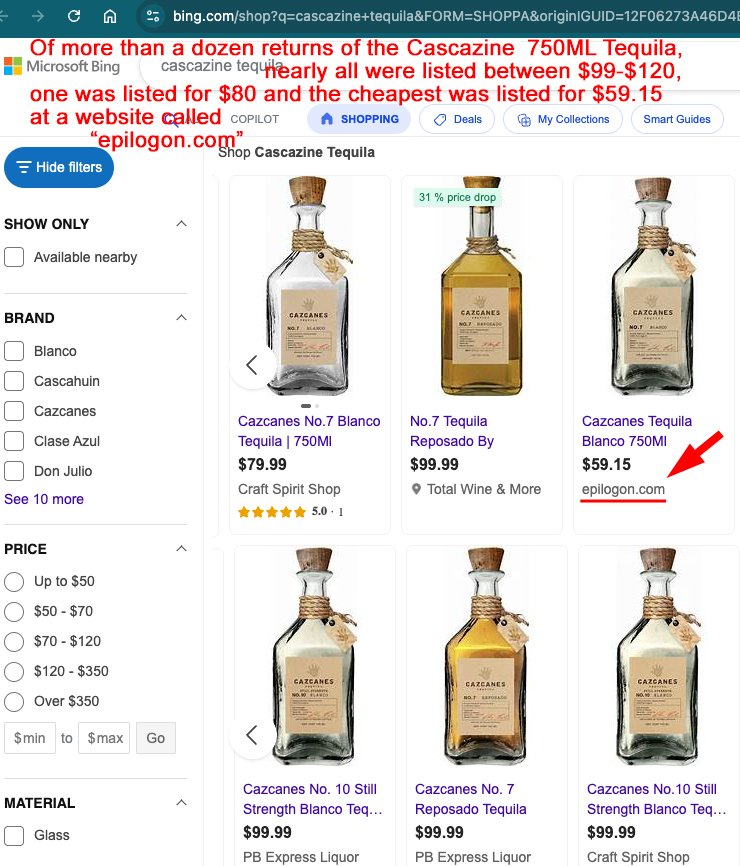
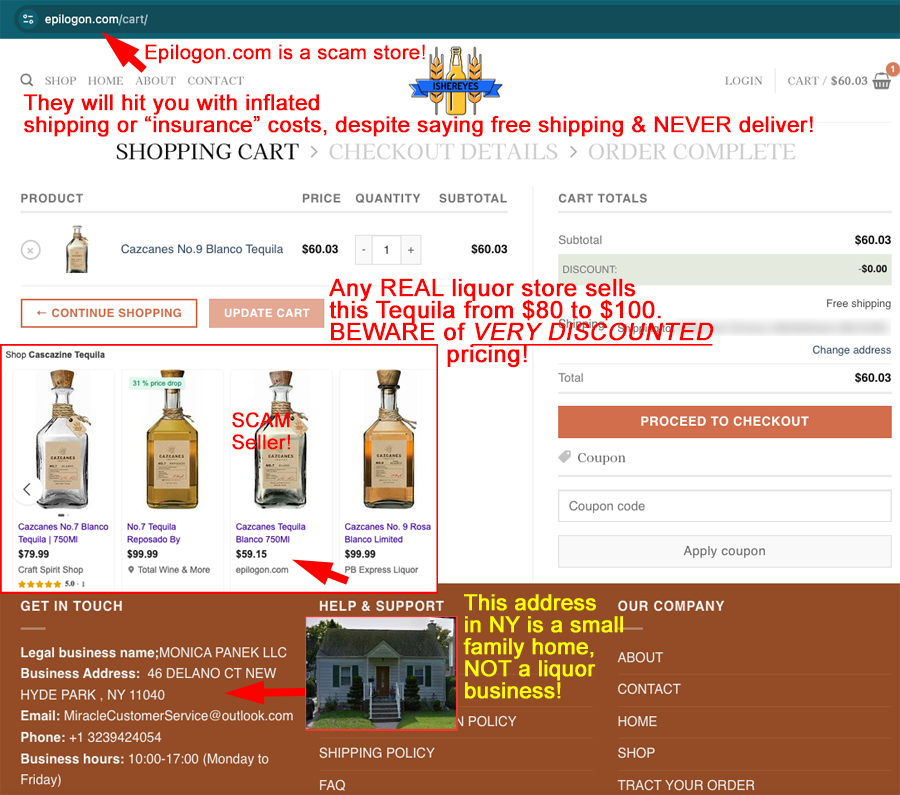
Since this heavily discounted liquor, 40 – 50% lower than nearly all of its peers, was so prominently displayed by Bing’s search engine, what could be wrong? David clicked the link to visit Epilogon.com. And he immediately noticed that a few things about this epic website seemed a bit off. For example, the price had been listed on Bing as $59.15 but when he arrived on the web page and added this item to his shopping cart, the price was listed as $60.03 for no particular reason. At the bottom of each webpage, the “Legal Business Name” was listed as MONIC PANEK LLC and an oddball email address was shown as MiracleCustomerService@outlook.com rather than an email associated with the website domain, or the business name. When we then looked up their listed business address of 46 Delan Ct., New Hyde Park, NY, we discovered a small single family home and NOT any type of liquor business or warehouse! And then perhaps most bizarre, a search for the company phone number, 323-942-4054, turns up two posts on the BBB.org’s Scamtracker website on May 23 and October 17 of last year, as well as other scam-related websites including a post on Scampulse.com about scam pet supplies last September. In each case, losses appeared to be small, about $60 – $100.
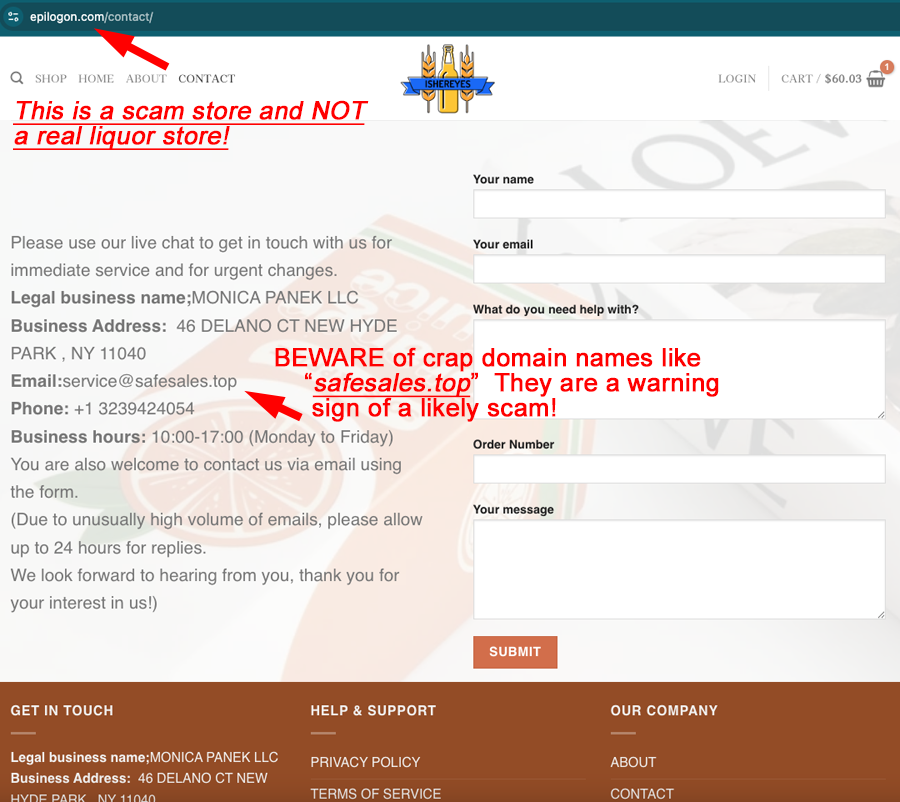
By this time, David knew this site was a fraud and further investigated by visiting the Contact webpage at the epilogon.com online liquor store. He was not surprised to find a new email address listed there that uses a “crap” domain named SafeSales[.]top. This domain was registered on June 29, 2024 by someone in Hong Kong. Oddly, it turns out that epilogon.com was actually registered way back in 2008. However, though the WayBackMachine Internet Archive shows 19 screen captures from this website, there is no website content visible or the archive is so old that it doesn’t have permission to visit this website, on 18 of these 19 screen captures. ….Until January of 2025! That’s when this domain shows up as an online liquor store.
David’s tequila was clearly not going to be shipped from that small house in New Hyde Park, New York! So where was it coming from? That is, of course, the fraud! It wouldn’t be shipped at all because this business doesn’t exist. Also, based on other similar scam websites, we strongly suspect that his low cost tequila would have also included additional charges like a hefty insurance charge, but only after David paid for his initial order. These bogus charges typically get added on to a low cost bottle after the initial payment is made. Interestingly, the “About Us” page at this scammer’s website twice refers to themselves as “stadthaeuser” (using a lower case s). What also supports our belief that this website is 100% a fraud is the fact that a search for the “Legal Business Name” of Monika Panek LLC turns up this reference of another scam liquor store website at Scamminder.com. But in this case, the scam liquor website is called Cybersecco[.]com. This liquor store was rated 35/100 last September, 2024 by Scamminder’s AI. And the final nail into this coffin of fraud is that we discovered someone had posted (on March 31) on Scampulse.com that they were cheated out of $75 for the purchase of a $65 bottle of liquor from Epilogon.com.
Despite Bing’s disappointing ability to keep scam sites from displaying so prominently in David’s search results, he eventually found a delicious and reasonably affordable tequila. And then, completely unrelated, a week later we received a request for help from a businessman in South Korea. The man asked us if, in our opinion, we thought fastlinemsc.com was a real or fake shipping company. It took us no time at all to find evidence that this shipping company was absolutely a fraud, but we wanted to know why he was asking. Typically, fake shipping websites are the tail end of another fraud narrative. Sure enough, he had a story to tell us….
The owner of this small South Korean business told us that they needed to order a large amount of food products and went onto Google to search for them. He quickly found a company that placed high on Google’s list of returns and seemed affordable. It was called BLL Food & Drinks GMBH, using the website bllfooddrinksgmbh.com. On their “About Us” page, BLL Food & Drinks GMBH says “We are a customer-focused business, and our employees are just like our products—built quickly. In a quick-moving, dynamic market where change is the only constant, our expanding Trading competes.” They say their main office is located at Unterdorf 215, 5753 Saalbach Salzburg, Austria. The S. Korean business owner told us that he purchased five metric tons of Sesame Seeds as a trial order from BLL Food & Drinks GMBH company. But he added that he thought it was odd that this wholesale food company required him to use either Westernunion or MoneyGram for the payment transaction. He was not able to make a direct bank transfer or pay by a credit card, both of which are serious red flags! He paid the bill and was told that his product would be shipped to him by Fast Line MSC Shipping Logistics, who uses the website fastlinemsc.com. This shipping company states that it is headquartered in Germany and their documentation shows their address as WANHEIMER STR.90, 40468 DUSSELDORF GERMANY. But our search of this address shows that a different shipping business is located there in Germany, and called Ceva Logistics! (The Ceva Logistics domain was registered long ago in 2006). Also, we could NOT find any business called BLL Food & Drinks GMBH at the Salzburg, Austria address either!
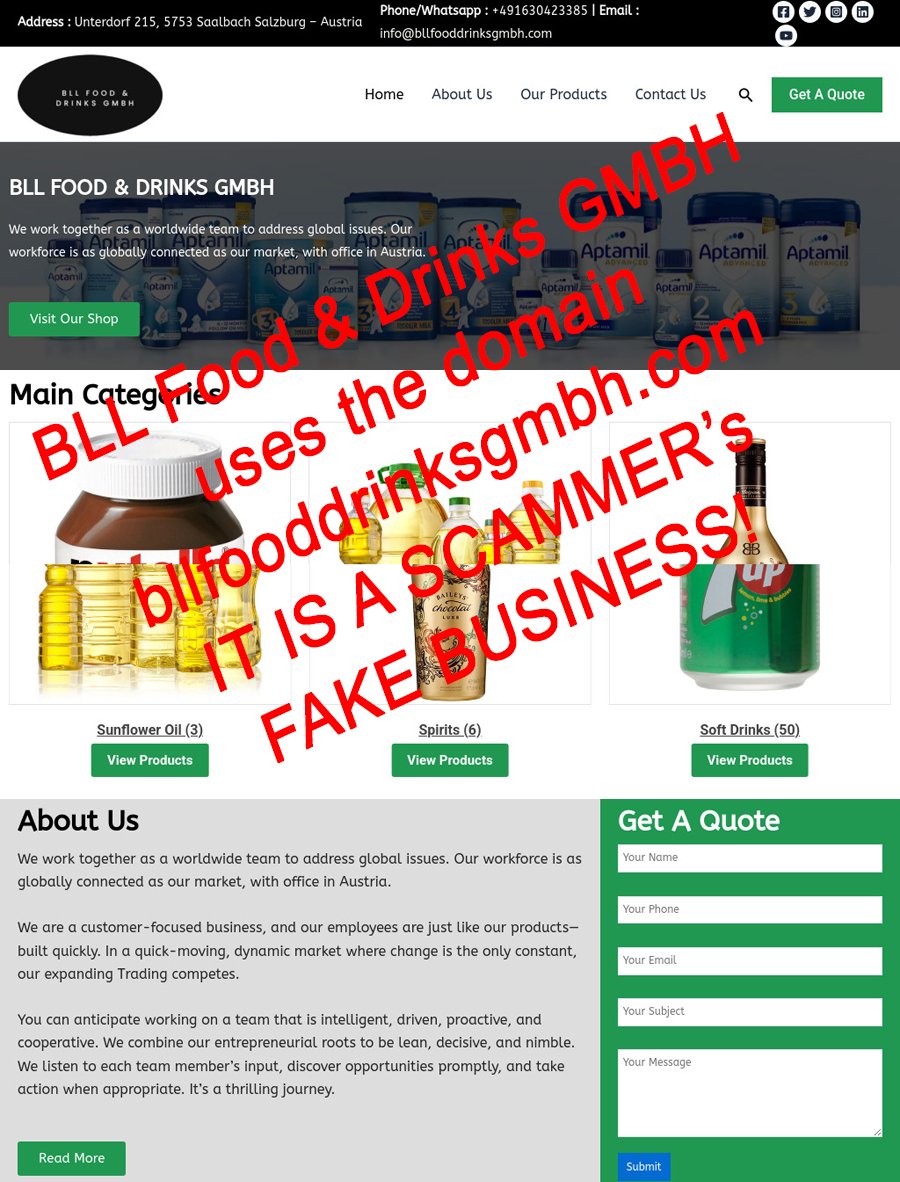
Experience has taught us that when someone is defrauded by a shipping company, it typically means that the other company or person moving materials through the fake shipping company is actually also a fraud! As you might expect, BLL Food & Drinks GMBH is a scammer’s website and used to trick buyers. However, unlike any other scam we’ve investigated, this fraud pretends to be an agricultural wholesaler and targets businesses! When we conducted a search for information about this company, we were surprised to find that this fake company was advertising on Alibaba.com. But, a website called Global Sources also posted a warning about this company. (See screenshot below.) (Globalsources.com is an online B2B marketplace and sourcing platform that connects buyers and suppliers worldwide, according to Google.)
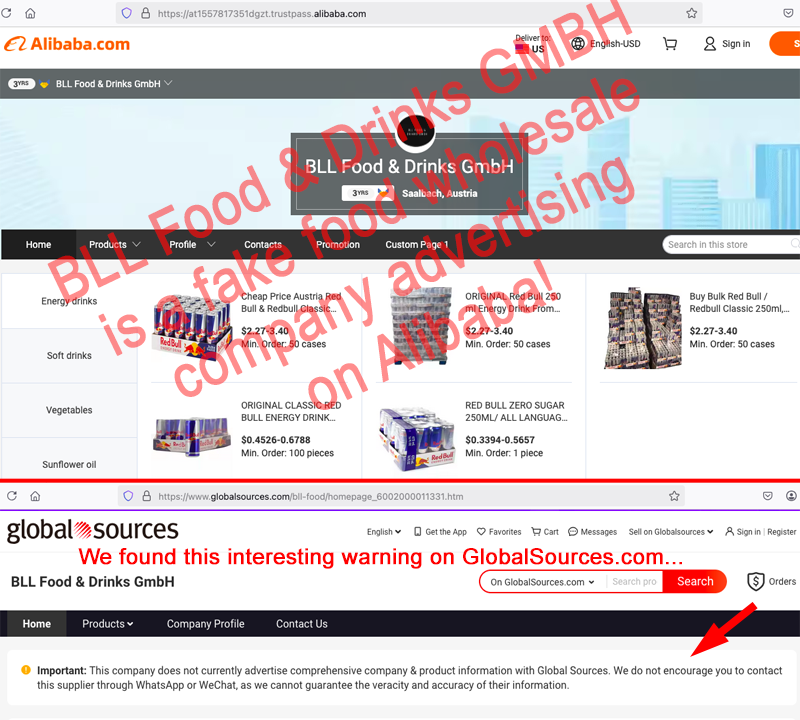
In fact, there are many warning signs on the internet about this bogus wholesale company if you take the time to look. For example…
- Scam-Detector gives bllfooddrinksgmbh.com a very low trust score, indicating it is risky!
- ScamAdviser.com lists bllfooddrinksgmbh.com as suspicious.
- Scamminder.com gives bllfooddrinksgmbh.com a very low trust score.
- If you conduct a Google search for reviews of BLL Food & Drinks GMBH you’ll find none! Moreover, you may also discover that this supposed wholesale agricultural business claims to sell a crazy wide variety of products including sheet metal and toothpaste.
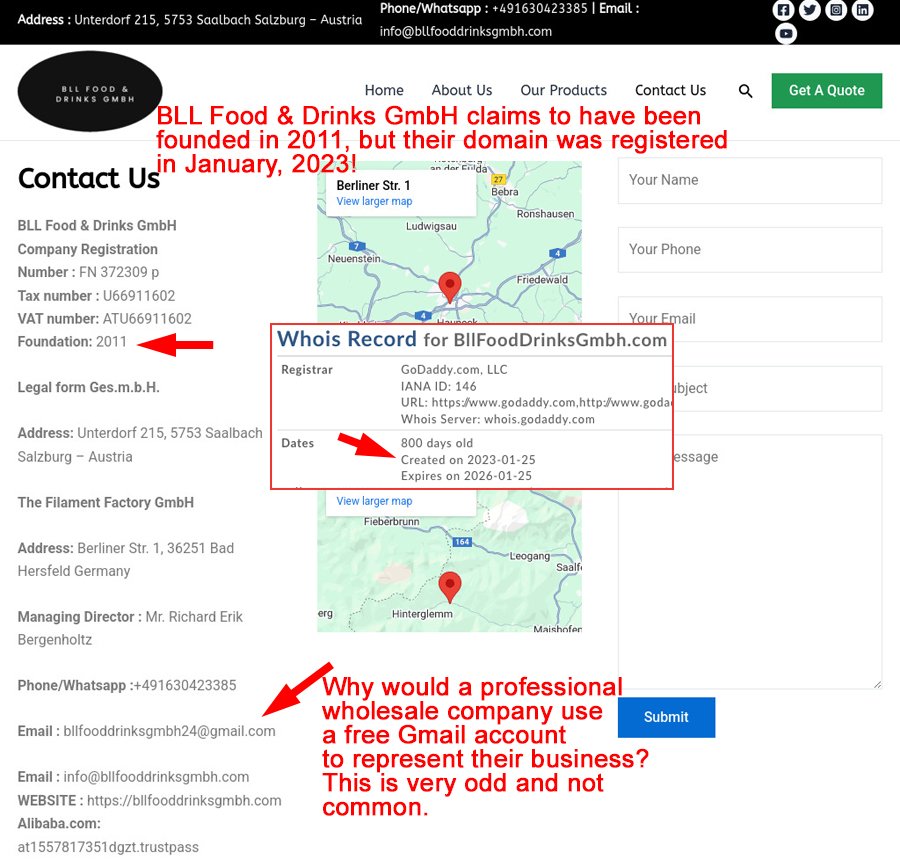
If you look at their Contact Us webpage at bllfooddrinksgmbh.com, you’ll see that it says they were founded in 2011. Then why is it that their domain was registered in January, 2023? Also, they show a free Gmail address on their Contact page which is very odd for a professional company to do.
You may recall that the South Korean businessman didn’t realize that he was being scammed until after he paid the shipping company Fast Line MSC Shipping Logistics to ship the 5 metric tons of seeds! And he had already purchased these seeds from BLL Food & Drinks GMBH. He told us “After they received all of money from us, they do not receive our call and never reply from email.” The shipping company was part of this fraud! It turns out that this bogus shipping company was already listed amongst the hundreds of fake shipping companies on our website at: https://www.thedailyscam.com/fake-shipping-companies/
(NOTE: If you visit our list of fake shipping companies, use Control-F (on a PC) or Command-F (on a Mac) and enter fastlinemsc to jump down to that listing.)
This financial loss could have been avoided if the businessman had done a bit of investigating before trusting these new companies. However, and not uncommon, he also told us that he is “old” and not terribly skilled at using the Internet.
It’s important to circle back to the most important point of these examples of fraud. The whole point of this article was to bring attention to the fact that online fraud is so much easier for scammers because search engines, like Google and Bing, don’t provide ANY built-in, automatic resources to identify fraud or suspicious websites as a part of their search results! This is NOT acceptable in today’s age of explosive online fraud! And, with their development of AI tools, this should be exceptionally easy to incorporate into search results! (Think of Google’s AI results that often appear at the top of page 1 results.) For example….
- Search engines should automatically look up the age and other information about a website domain to show to people. Younger domains should immediately be flagged as suspicious. AI should crawl a website and report inconsistencies with a company’s founding date and domain age, such as “founded in 2011” but registered in 2024!
- Search engines should automatically include score reports from several anti-scam tools such as those we’ve mentioned above! They should offer a warning in their Google listing if their own AI tools also finds a website domain name is listed on a site reporting fraud, such as on websites like ours, or Scamtracker at BBB.org.
- Search engines should automatically include low trust ratings from sites like Yelp, Trustpilot, BBB.org, and of course Google reviews. AND, if there are no reviews at all found by their AI tools, that should be reported as well since it could be a warning sign, especially if a website is more than a year old!
It is a completely new and dangerous Internet era as a result of the massive worldwide explosion of online fraud! We must demand that the companies that produce everyday tools used to connect with and search the internet step up and provide better protections for consumers around the world!
REMINDER: There are many more fake online businesses that turn up in a Google or Bing search. Scamadviser recently posted an article about anoth fake store, selling products at absurdly cheap prices…
https://www.scamadviser.com/articles/is-cheapeststoreru-legit-or-a-scam
About pricing, if it seems too good to be true, it is!
Approved Advertisement
Factual Information in Times of Uncertainty, Social Media Posts about Voting Rights & More!
To say “we live in uncertain times” almost sounds cliche today. But I am certain that many Americans, and citizens in other countries, think the world today feels less safe, predictable and reliable than it did even 10-15 years ago. The current Tariff war from the United States government and its impact on global markets, the literal war in Ukraine by Russia, along with it’s alleged proxy targets across Europe, severe storms from climate change, as well as the veritable deluge of misinformation/disinformation campaigns in social media and elsewhere, all contribute to this feeling of unease, uncertainty and insecurity. It’s sometimes hard to know where to look for the truth about what is happening around us. As the Content Director for TheDailyScam.com, a blog focused on exposing online fraud, dilineating truth from fiction online is extremely important. Many times, I find myself reading something and wondering “is this accurate? Is this true?” Or am I being manipulated by bias, misinformation or a targeted disinformation campaign? A recent example came up last week when one of my friends reposted something on Facebook that appears to have originated by a group called The Guardians of Democracy. It said, in the United States “8 in 10 married women have changed their surname which means they don’t have a birth certificate that matches their current legal name. 69 million women have to get new IDs to vote under the SAVE Act. The GOP is trying to silence women across the country.” I personally found this post to be very concerning. The SAVE Act appears to have originated from very Conservative members of our Congress as a result of unproven theories that voting in the United States is littered with fraud. However, other than a handful of proven cases of voter fraud, there has never been any factual basis with evidence supporting any of these claims, going back years including the 2020 election.
When I first saw this social media post on April 11 about the SAVE Act, it resonated with my understanding of the very right-leaning push to restrict elections across the United States. But again, I wondered, is this post accurate? It turns out that this post is true in part, BUT it is also misleading! I then read this outstanding article on FactCheck.org titled Will SAVE Act Prevent Married Women from Registering to Vote? (Published February, 28, 2025). According to the FactCheck article, although some women will absolutely be impacted negatively by the SAVE Act as it is currently written, an overwhelming majority will not because they already have other acceptable forms of identification that are allowed by the SAVE Act, such as a US Passport, a government-issued photo ID, or a REAL ID Driver’s License. (A “REAL ID” is required nationally by May 7 for anyone wishing to fly domestically on all commercial aircraft.) Also, in order to vote, veterans and members of the US Military can show a US Military ID but only if it is shown with a military record of service that also shows the United States as the applicant’s birthplace. And, according to the FactCheck article, there are many other ways that people can prove citizenship that vary by State. My point here is that yes, the SAVE Act will likely make it very difficult for some women to vote due to unfair demands and restrictions! However, it likely isn’t anywhere near the 69 million voters as suggested in the Facebook post. For example, it is reasonable to believe that many of these American women will have either a US Passport or a REAL ID for their Driver’s License. (According to 2022 Statistic Reports, there were about 68.45 million married women living in the United States at that time. And according to other credible sources, including our own government, by early 2025 about 45-50% of Americans had valid US Passports. So it is reasonable to assume that many of the currently married 69 million American women have valid US passports! And, as previously stated, a driver’s license that is also a REAL ID is very likely held by millions of married woman across the US, especially with the May 7th deadline looming for those who wish to use domestic air travel.)
Regardless of the actual number, the fact that any American citizen, might lose her or his right to vote because of a poorly written, possibly biased, SAVE Act is wrong. And this is especially true if this right is lost because a woman simply chose to follow traditional marriage naming conventions! Fortunately, the SAVE Act has not yet been voted into law. And the outstanding article on Factcheck.org can help women understand if they will still be able to vote should it become law, and what steps they must take to protect their voting rights. Given how important voting rights are to our American Democracy, we encourage you to share this information with friends and family. Fraud refers to intentionally deceiving someone. Though it is usually carried out for someone else’s financial gain, all too often it is also carried out as a way to falsely manipulate others, sway their way of thinking, or to diminish their rights and abilities.
Today, more than ever, it is critically important to check facts before you believe information that may have consequences and implications in your lives! I have several important recommendations to help people navigate through all the noise and distractions. I have been visiting these sites for years and have found them to be extremely truthful and reliable, as already noted in my evaluation of the SAVE Act Facebook post. These websites, listed below, have helped me to see through online bias, misinformation and fraud. When you see news or information that seems biased, or feels unimaginable, or that is spreading across social media from unknown sources, STOP for a moment! Before you believe what you see, or pass it on to others, consider using these resources to help you understand if what you are reading/seeing is true or if it is heavily biased, left or right:
- FactCheck.org – An outstanding website from the Annenberg Public Policy Center at UPENN.
Two recent articles/areas of their website, for example, are….
“How to Combat Misinformation” (published April 2, 2025)
“Debunking Viral Claims” on Social Media such as Facebook (with links to multiple articles)
- MediaBiasFactCheck.com – An outstanding service describing themselves as “an independent website that has promoted awareness of media bias and misinformation by rating the bias, factual accuracy, and credibility of media sources, large and small.” This excellent service, for example, provides a list of many dozens of news sites that are rated very high for factual, least biased reporting of events, along with how/why they were given this designation! Their methodology and analysis is also outstanding. For example, it probably wouldn’t surprise our readers that MediaBiasFactCheck rates the MSNBC as “MIXED” for factual reporting and also a bias rating that is very left of center. Or that Fox News is rated as “MIXED” for factual reporting and a bias rating that is very right of center. By contrast, news services rated as least biased, and very high factual reporting can be found listed on their “Center” page and include C-Span, Center for Responsive Politics (via their website OpenSecrets.org) and USAFacts.org.
- An outstanding resource for schools, teachers & students is the News Literacy Project at https://newslit.org/educators/resources/in-brief-news-media-bias/ Their Checkology Project is a great tool to be used in Middle and High School teaching! Also, their RumorGuard.org site offers a fascinating look at disinformation manipulation in relevant newsworthy information!
- AllSides.com is another excellent resource to help you understand bias, truth from lies and includes a media bias section.
(NOTE: A valuable search method you can use to search for specific content on these websites above is to use the “Site:” command in Google. This short YouTube video explains how to do this.)
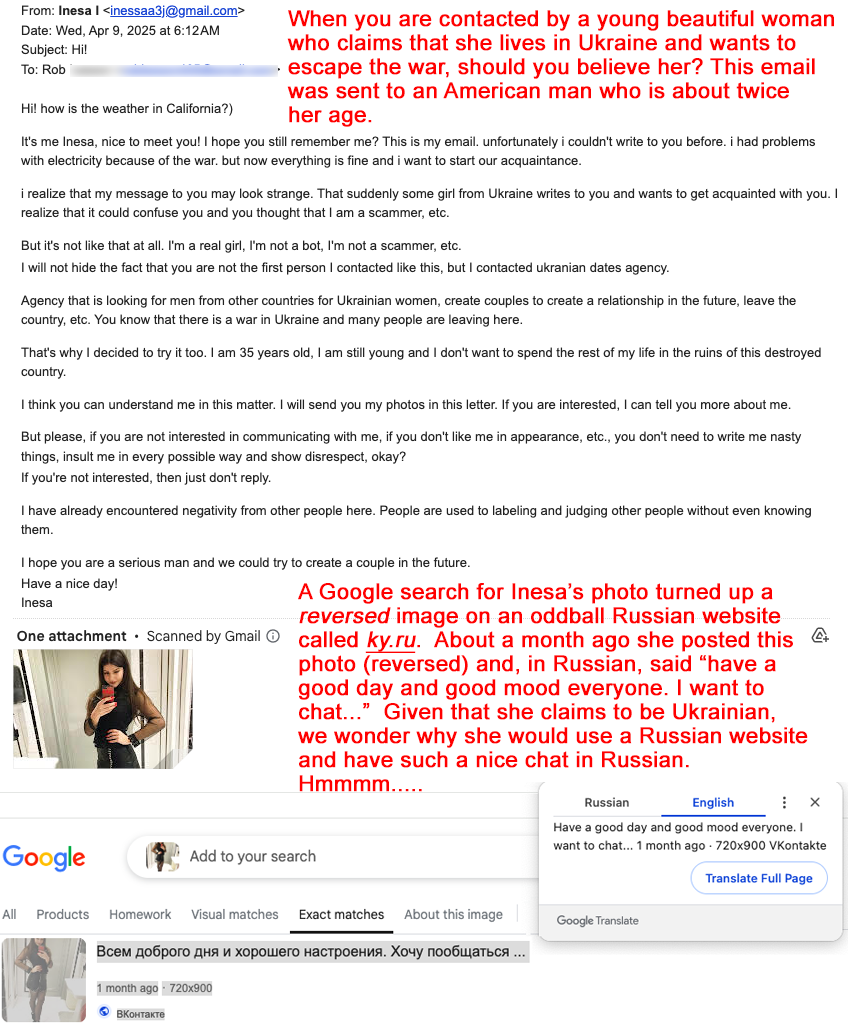
Our friend Rob continues to get emails from beautiful women from Eastern Europe. We can’t help but notice that many (most?) of these women who are randomly looking for love online claim to be from Ukraine. Given the horrible tragedy of Russia’s war against Ukraine, can you blame them? But when we discovered that a supposedly Ukrainian woman, named Inesa, also recently posted to a text thread on a Russian website, in Russian, we had to wonder if she was lying to Rob about her home country! Russia has brutallly and unfairly destroyed so much of Ukraine, killing thousands of innocent women, children and men. Why would a young, beautiful Ukranian woman feel OK about chatting on a Russian website? It certainly feels odd to us, just like her willingness to reach out to a man who could be her father’s age….
Other worthwhile articles about online fraud recently include…
Malwarebytes recently published some interesting articles that may interest our readers. They include…
Tax fraud targeting Americans typically explodes at this time of the year. This year is no different! Check out this recent example of a tax scam meant to phish your login credentials…
Phishermen are increasingly using QR codes as their means to target victims:
Parents of young children sometimes use tracking services to keep tabs on where their kids are. But what if these tracking services messed up and start showing you random photos and locations of other children? How would that make you feel about the data associated with your own children? Apparently, this is alleged to have happened to a tracking service called SyncUp from T-Mobile:
Unfortunately, people’s official IDs are sometimes stolen or lost. And sometimes people are tricked into giving copies of their IDs to fraudsters around the globe. But could you ever guess that a stolen/missing ID could result in ruining a man’s life because the thief added a criminal record to the victim’s life? Check out this crazy story about a young man impacted by this event….
Oh, the cleverness of scammers! Would you believe that some have tricked people to click a link while in a Zoom call that results in malware being installed on their computers? Check out this article on Scamadviser…
https://www.scamadviser.com/articles/hackers-are-hijacking-zoom-calls-dont-click-that-link
Could you imagine that foreigners with the proper authority to live and work in the UK are also scamming their own citizens in their home countries through job scams? BBC Reporters even caught an African Doctor running this scam while working in the UK! Visit: https://www.bbc.com/news/articles/c1en4dx7yn9o
We Appreciate Your Order, Suspicious Signin, & Docusign
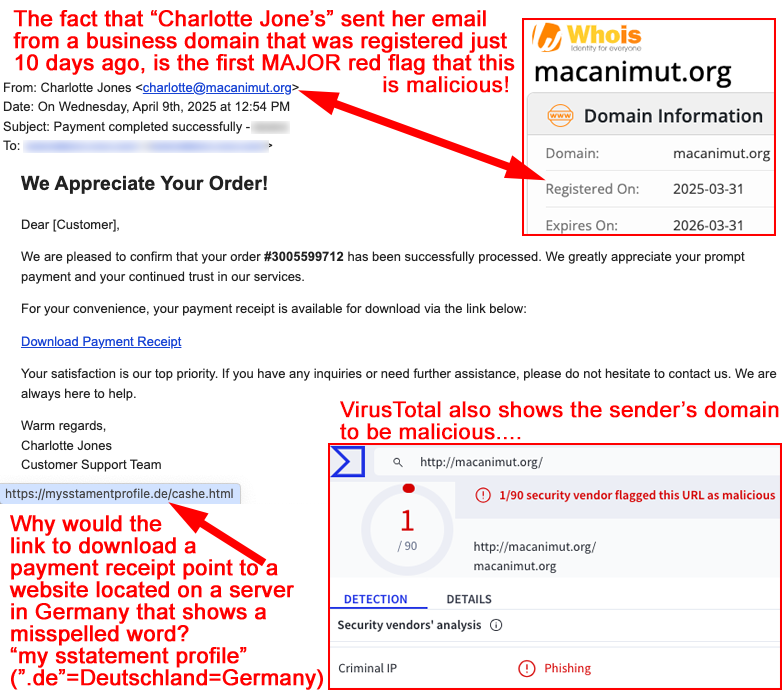
Our first smelly phish this week was sent recently to an accountant. This email doesn’t even inform the person about WHAT was ordered! But it came from someone named Charlotte Jones at her domain macanimut[.]org and the link in this clickbait points to a perfectly and sensibly named website called MySStamentProfile[.]de. What, you say? Is that short for “my statement profile?” First of all, that misspelled website was registered just 10 days ago and in Germany! (“.de” = Deutschland = Germany). Sadly, Charlotte’s domain, macanimut[.]org has already been identified as a phishing fraud. Delete, but we appreciate your effort.
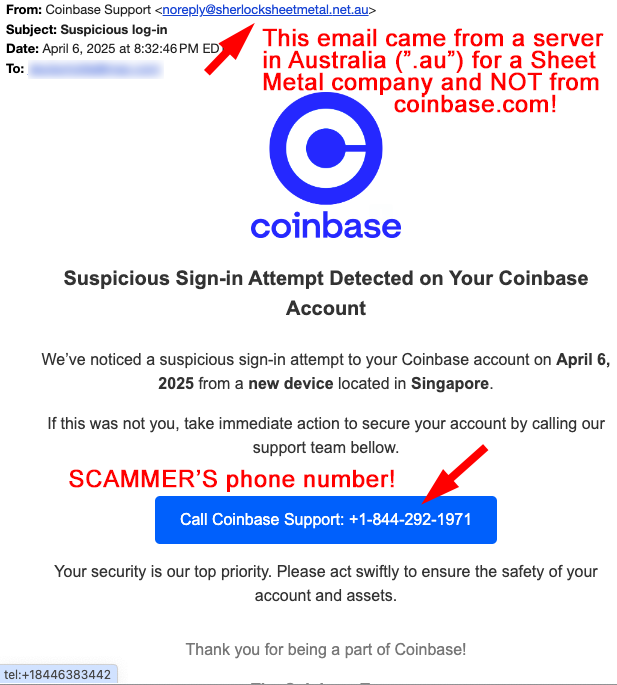
In case you didn’t know, Coinbase is a cryptocurrency exchange. This next rotten phish clearly wants you to believe it was sent by Coinbase Support but that name was simply entered into the text field of the FROM address. This rotten phish was sent from a sheet metal company’s server in Australia! Not from coinbase.com. So don’t bother calling them at 844-292-1971 because it’s just another scammer phone number! HOWEVER, if you care to pull out your noise-canceling headphones and Airhorn can, please call them often!
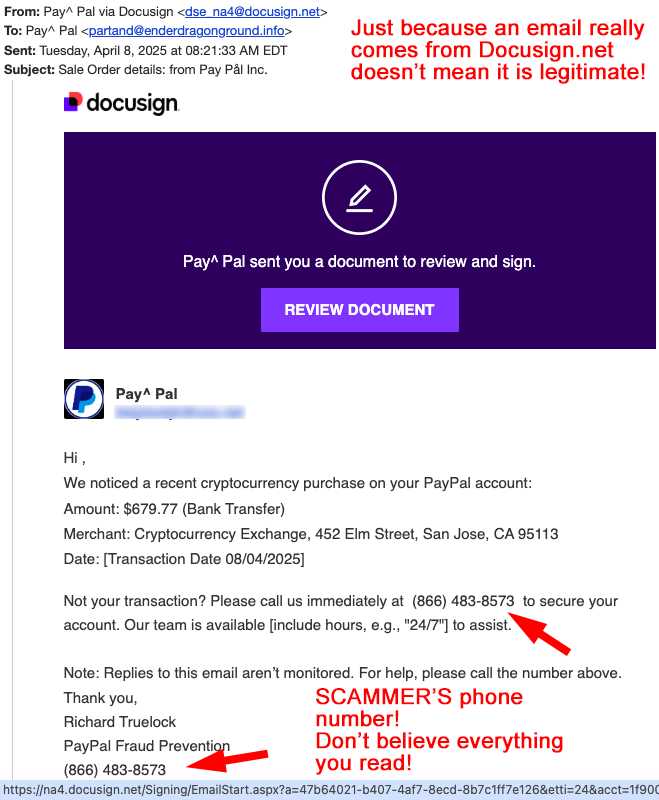
Yes, this third smelly phish did actually come from Docusign.net, a legitimate company website. But that doesn’t make the content legitimate! Scammers simply created a fake Docusign account and then created a fake document and sent out emails by the thousands using bogus information in the email notes field! You didn’t have a recent cryptocurrency purchase on your Paypal account. But you DID have a scammer try to trick you into calling them at 866-483-8573. Do you have your Airhorn can ready?
Remember to report your smelly phish to us and Google!
https://safebrowsing.google.com/safebrowsing/report_phish/
Luxury Watches & Your Netflix Membership Has Expired
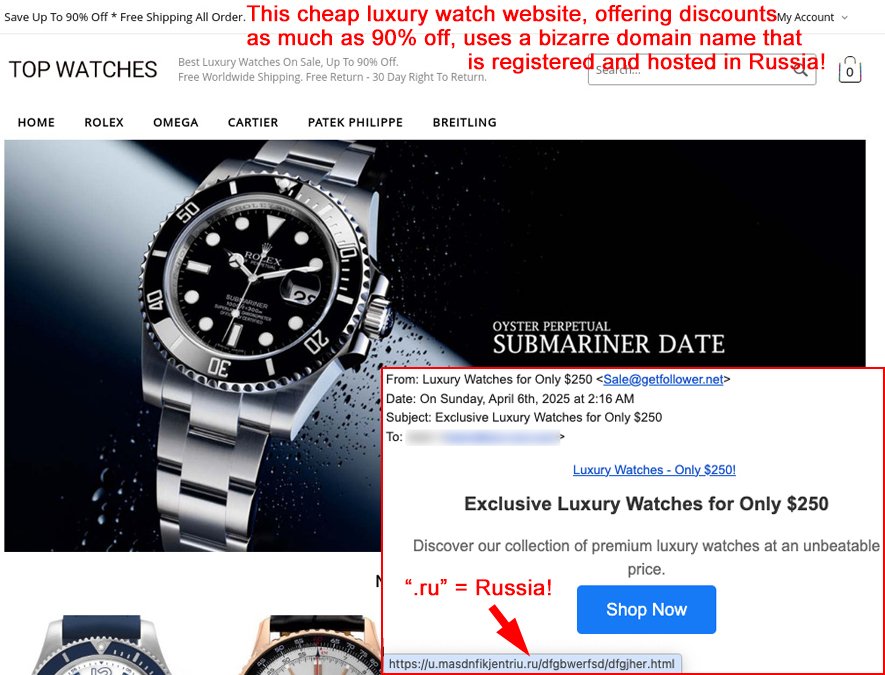
Thinking of Russia just warms the heart, doesn’t it? One of our readers shared this awesome email and website with us about “Luxury Watches for Only $250!” Guess where this website is located? That’s right, Russia! The website domain name is such a crazy, nonsensical mix of letters that we can’t begin to imagine how to pronounce it! Maybe it’s time for some Russian language lessons? According to this WHOIS record, this crazy-name website was registered on August 28, 2024. With prices as much as 90% off, are we worried about anything going wrong about this great deal? Hell yes! VirusTotal shows multiple security services saying that this website is malicious!
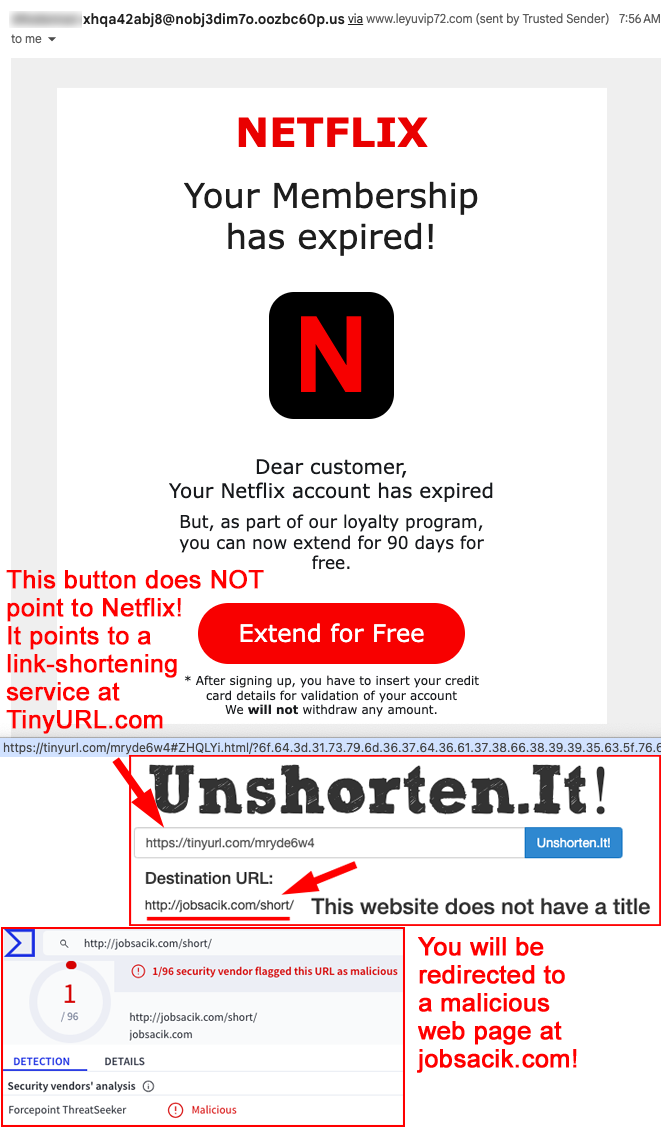
Oh no! Your Netflix membership has expired! How will we ever finish The Residence or The Long Island Serial Killer! **GASP** But before you click that link, we hope you’ll notice that this email didn’t come from netflix.com and the link certainly doesn’t point to it! In fact, the link points to a link-shortening service. (NOTE: Everything after the # symbol, including the “#” symbol itself, is not important and can be discarded if you wish to unshorten a link using tools like Unshorten.it or Urlex.org.) When we unshortened that link, we discovered that we’ll be redirected to a malicious website called jobsacik[.]com. LUNGE for the delete key!
New Document Shared with with you & New Incoming Voice Message
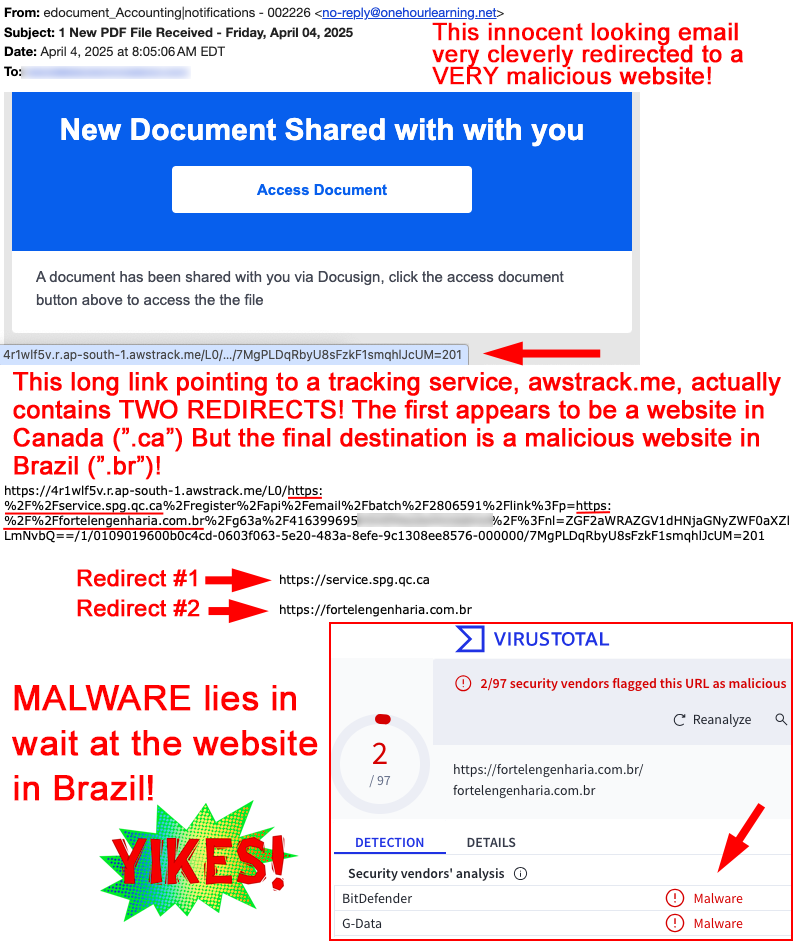
OK, we say it over and over….and it’s true! DETAILS MATTER! Check out this email sent to an accounting firm. In the big, bright, blue box it says “New Document Shared with with you.” And this email wants you to think it came from Docusign?? That’s that’s nonsense! However, what we DID find interesting about this very malicious clickbait is that the very looooooong link to “Access Document” actually contained, not one, but TWO redirects! To make it easier for you to see how redirects are built into some links, check out the screenshot below. If you see another “http” or “https” inside of a link (rather than at the start of a link), it means you’re going to be redirected to a different website than you think. In this link, you are first led to believe that you’ll be visiting the click-tracking service at awstrack[.}me. But that is followed by a redirect to a website in Canada called qc[.]ca. Except…SURPRISE, you’ll actually be redirected to a website in Brazil called fortelengenharia[.]com[.]br where malware eagerly waits for your arrival!
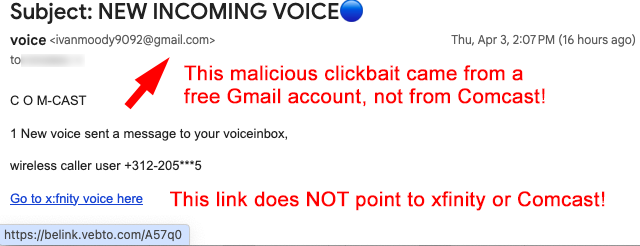
As if the above email wasn’t bad enough, here’s a lovely malicious clickbait that one of our readers sent us recently. It pretended to be a “new incoming voice” message from Comcast, spelled: C O M-CAST. Right. Like that spelling would never arouse suspicions that this tomfoolery could be malicious! Of course the link saying “Go to x:finity voice here” doesn’t point to either Xfinity or Comcast! Delete!
Apple Approval Notice, We Have an Opening, and DMV Unpaid Bill
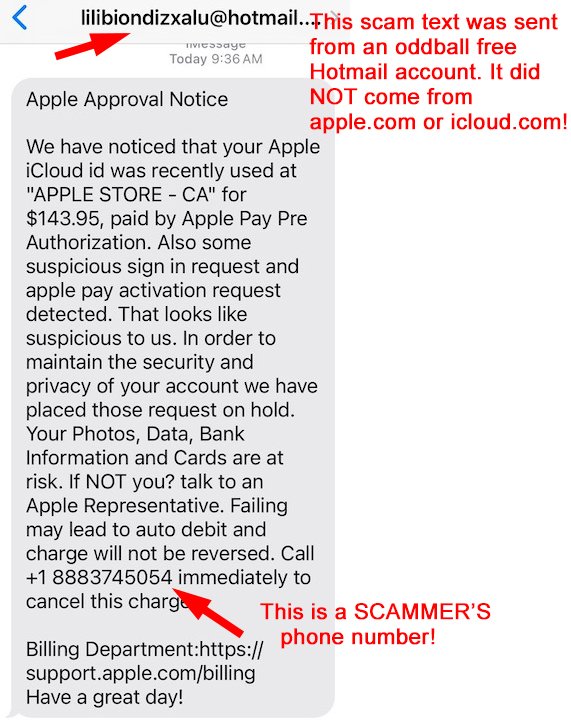
When an email from an oddball Hotmail account arrives in your text messages claiming to be an Apple Approval Notice, swipe left and hit DELETE! Trust us when we say that there is NO pre-authorized charge on any of your accounts! So, unless you have your Airhorn can and noise-cancelling headphones ready, DO NOT call these scammers at 888-374-5054.
Ahhhhhh……. Lily, Lily, Lily! You’re not listening to me! Why, oh why, won’t you read my responses to your recent job offer? And yet, over a five hour period you kept coming back with new texts to get my attention. Oh well. Your lack of interest in my responses simply means that I must block your phone number. Somehow, I’m sure I’ll hear from you again using another bogus number soon…

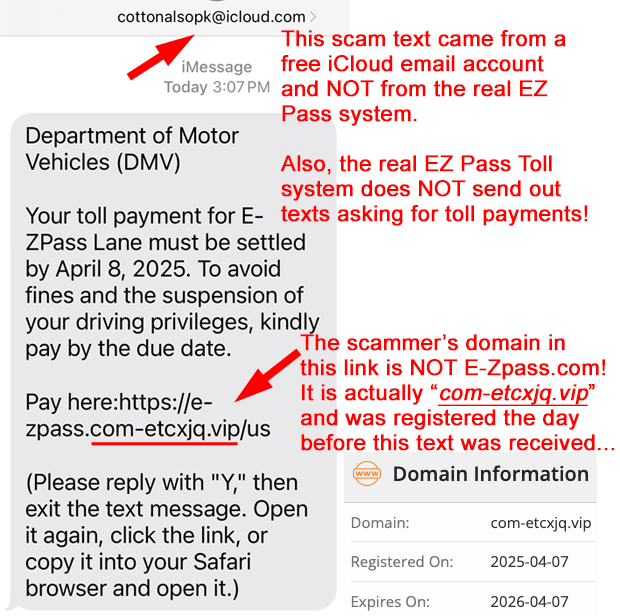
These bogus toll payment texts are driving everyone nuts! (**EYEROLL**) As if you didn’t already know, the real EZ Pass Toll Service will NEVER text you for something like this even if you had an unpaid fine! And certainly not from a random, bizarre iCloud email account!
Deeeeeeeleeeeeeete!
Until next week, surf safely!
Copyright © 2025 The Daily Scam. All rights reserved. You are receiving this email because you have subscribed to thedailyscam.com
Marblehead, MA 01945