

THE NEWSLETTER | 05.14.25 | V05N14
Co-Founder/Content: Doug Fodeman | Co-Founder/Creative: David Deutsch | Scambaiter: Rob M

Approved Advertisement


What If Your Lawyer Was a Fraud?
In April, while conducting an investigation into fake online shipping companies, we unexpectedly came upon an impressive website for a Law Firm and Attorney named John Matthew. Clicking the link to arrive at a Law Firm’s website, FastBeeTech.com, was truly a surprise! Our initial reaction was that we were impressed by the opening top section of Attorney John Matthew’s website and starting scrolling. His firm handles a great many types of law, from custody battles, divorce and separation to adoption, surrogacy, property settlements, domestic violence and more. His website even included a quote from a woman who said “John Matthew is aware that every case he takes on helps families get closure and makes hospitals responsible for their careless action.” And we thought, WOW! This seems exactly like the type of law firm we would want when dealing with a tough personal matter! But as we began looking into the website for John Matthew’s Law Firm we began to see more and more suspicious evidence that, perhaps, John Matthew and his Law Firm were fake! Read on as we lay out our suspicions and then tell us if you also think that this impressive firm is just another online fraudster…

Seeing that young, handsome lawyer leaning over his desk and staring us in the face, while surrounded by tomes of legal texts, and balanced by a beautiful leather chair on one side and an Apple computer on the other was impressive! This was much like a great opening line of a powerful book or play. Both “Where’s Papa going with that axe?” from E.B. White’s book Charlotte’s Web and “I come no more to make you laugh” from Shakespeare’s Henry VIII, come to mind as we stare at that opening web image. And this is artfully counterbalanced with powerful signs of empathy offering hints at some of the ways this Law Firm can help you and your family! Check out these three quotes found on their Practice Area web page, presumably from Attorneys Benjamin Richardson, Gloria Rose and Walter Myers…

Given the outstanding services that this strong, fight-for-you Law Firm Team appears to offer clients, why would we ever think that it’s all just a clever facade? And yet, once we started picking at a few noticeable cracks in this Law Firm’s wall of impressiveness, we then saw LOTS of things that struck us as suspicious or odd about this professional Law Firm. In fact, our list of suspicious facts and things that don’t reflect well about the John Matthew Law Firm grew to more than a dozen long! Here are the things we found to be suspicious, unprofessional or odd…
- The John Matthew Law Firm says their office is located in Austin, Texas but nowhere on their website do they provide a street address for their offices.
- Their Contact page invites people to follow them on the social media services of Facebook, Instagram and LinkedIn. But NONE of these links points to any account for this law firm. The links simply point to the social media domains themselves. And, for example, we conducted a search on LinkedIn several different ways and still never found this law firm.
- Their Contact webpage offers a free Gmail address for contact rather than a professional email at their own domain. The Gmail is: johnmatthew0147@gmail.com
- We’re pretty certain that any Sixth grader can tell you how to spell “contact” – C O N T A C T. Look carefully at the link for their Contact webpage and you’ll see that it is spelled “conatct.” That’s embarrassing for a web designer to make that mistake but even MORE EMBARRASSING that no one at this law firm noticed it and had it corrected.
- Not that it is so terribly important, but we did wonder why a Law Firm located in Austin, Texas would use a phone number with a North Carolina area code.

- The John Matthew Law Firm has a convenient “Fequently Asked Questions” web page. On this webpage the Firm impressively states that they have over 20 years experience! However, if that were true, why did they wait until July 9, 2024 to register their odd domain name of FastBeeTech.com? Also, why would they post on their “About Us” webpage that they have “over 5 years experience,” though technically, “over 5” could also mean “over 20.”
7. We thought that two of the opening paragraphs on their FAQ webpage were worded rather strangely, as if they were copied from a website template purchased for this business and never updated. These paragraphs both say “This paragraph is also for those who are looking out for a reliable attorney. You can use a few enticing words and flaunt your capabilities…” Ok, nice to know.

#8-10. In the second screenshot above, taken from the “Practice Area” web page of the John Matthew website, it shows quotes from Benjamin Richardson, Gloria Rose and Walter Myers. The text on the page gives us the impression that these people are very likely three of the 10+ Attorneys for the John Mattew Law firm. It’s reasonable to expect that the photos accompanying these quotes are the people represented by the names, right? That’s what we would think. However, when we searched the Internet for each of their photos we found them on LOTS of other websites…
- The photo of Mr. Benjamin Richardson turned up on more than 85 websites across the Internet with lots of other names associated with it. (To repeat our findings, conduct a Google image search for the photo in this link: https://lawyer.fastbeetech.com/wp-content/uploads/2024/07/law-icon10-3-free-img.png ) AND this exact photo is also used to represent a glowing review of this law firm on their top page by a man identified as Terry Franklin! Why use the same photo for a testimonial AND a lawyer at the firm?
- The photo of the woman named Gloria Rose shows up in more than 60 different websites across the Internet, many of them also showing different names, or that they are stock images available on websites. (https://lawyer.fastbeetech.com/wp-content/uploads/2024/07/law-icon10-5-free-img.png) Also coincidentally, this SAME photo is used as the photo for a woman named Shirley Parker on the John Matthew website. Shirley Parker is one of two glowing reviews given to this law firm. Again, why use the same photo for a testimonial AND a lawyer at the firm?
- The same is true for a photo of the employee named Walter Myers. (https://lawyer.fastbeetech.com/wp-content/uploads/2024/07/law-icon10-2-free-img.png) His photo can also be found on more than 20 websites across the Internet, including as a man named Michael Johnston who posted a review on another San Antonio, Texas law firm’s website.
NOTE: We also find it interesting that each of these supposed employee’s or reviewer’s photos are listed in the file name as a numbered “free-img.png” source. Were they just free images taken from a stock photo service?


- On their About Us webpage, there is a prominent photo of “Advocate Beverly Holmes,” along with a very touching statement about their work. While this statement feels very meaningful, we were under the impression that the photo was actually a photo of Advocate Beverly Holmes as she faced a couple turned away from the camera. However, like other photos of people on the John Mattew Law Firm website, this turned out to be a stock image. The photo is called “three-women-sitting-beside-table.” That file name is certainly true!
https://lawyer.fastbeetech.com/wp-content/uploads/2024/07/three-women-sitting-beside-table.jpg

When we conducted a Google search for this photo, we easily found it on more than 150 other websites!
In fact, that striking opening photograph of a man leaning over his desk, with a wall of books behind him, and the leather chair on one side and Apple computer on the other, is also a stock photo that appears to have come from the website called Pexels.com. Hmmmm….. Perhaps John Matthew decided that he would rather not post any real photos of himself or the people who work at his firm? Though a bit misleading, we suppose this is possible.

- There are spelling errors in prominent areas on this Attorney’s website, as well as nonsense text that clearly show this website was a stock template posted online and little effort or attention went into making it into a professional law firm’s website, as one would expect. We would rather not point out these errors, just in case this very professional Law Firm (said dripping with sarcasm) reads our story. We certainly don’t want to make it too easy for them to make a more convincing website! These errors do, once again, bring into question the professionalism of the site’s owner and his employees. Why wouldn’t they notice these errors? Perhaps they are dumber that they appear to be? Perhaps the site’s creator is not a native English speaker and is a scammer in some other country? Hmmmm…. We did find one tiny piece of evidence on their website that supports this last statement. We found one word on their website that is not written in the typical American way. It’s written in UK English, which is also how many other English-speakers around the world learned to speak English. Again, we would rather not give away this single oddly spelled word in case one of the people behind this highly credible law firm should read this article.
- For lucky #13, let’s get serious about our suspicions that the John Matthew Law Firm website is a possible fraud. On their About Us webpage, they have a section called “History & Expertise.” In this section they state (twice, in fact) that someone, presumably John Matthew, has a J.D. from William Mitchell College of Law. And, more importantly, that he has passed the Bar in both New York and California (“Bar Admissions” – source: Wikipedia) and can legally practice law. (See below.) (They also claim that this person graduated 5th in his/her class! But we can’t verify that, of course.) Though It isn’t exactly quite clear whether this information is related to John Matthew himself, or to the Advocate named Beverly Holmes, one thing is crystal clear to us. States across our nation provide searchable websites for people to look up Attorneys who are licensed to practice in a state, and/or who have passed the bar exam. We cannot find either John Matthew or Beverly Holmes names listed as alive and eligible to practice law in California, as per the California Bar Association website:
- John Matthew search results for California (NOTE: There was an Attorney John Matthew licensed in 1964 but his license was revoked in 1999.)
- Beverly Holmes search results for California show NO results at all.
We also tried to search the Attorney Online Search Service available for the New York State Unified Court System. Neither John Matthew, nor Beverly Holmes appear in a search for their names in this New York State database.

- Remember that this Law Firm lists their address in Austin, Texas? We can add another virtual nail in this bogus Attorney’s coffin by reporting that we also checked the Texas State Bar “Find a Lawyer” website for attorney’s in Texas. Surprise! We cannot find either a John Matthew or Beverly Holmes in Austin, Texas.
And so it would seem that either this John Matthew Law Firm is completely incompetent, or perhaps more likely, they are a fraud. Experts say that AI is pretty smart nowadays. We asked Google for reviews or complaints about this law firm’s website, FastBeeTech.com and it reported to us that there was no evidence that such a law firm existed. Google’s AI said that such a “law firm” could be a scam! Now, if the John Matthew law firm wants to sue us for liable based on this story, we want him to know that we have the support and backing of a real and powerful law firm based in Boston, Massachusetts. So, bring it on! Oh, and by the way, we also found a couple of interesting and oddly phrased statements on the John Matthew Law Firm’s website. When we used Google to search for these exact statements we were not the least bit surprised to find more than 80 other websites come back in our search results. Apparently, we’ve got some investigative work ahead of us. And to our longtime readers, you already know that this is the part of our story where we say don’t take anything at face value online! It is simply too easy to deceive others. Verify, VERIFY, VERIFY!

FOOTNOTE: We often wonder who are the fraudsters behind a fake website and where in the world they live. Sometimes we find breadcrumbs on a fake website, or “under the hood” in the coding of a fake website that suggests or reveals this information. Another interesting clue about this particular website concerned the small image used to represent Benjamin Richardson. We found this image representing a Serbian musician named Lazar Stojanović on his Soundcloud account and wondered if the creators of this bogus website were from south eastern Europe or even Russia. Perhaps one of them knew this man’s music and decided to grab his image to put into this Law Firm’s website? Hmmmmm…..
Approved Advertisement


Reward for a Lost Cat, Tips for Protecting Yourself Online, and More!
It can be heartbreaking when you lose a pet! We’re guessing that all of our readers have seen signs appear around their neighborhoods at some point asking folks if they have seen a lost dog or cat. Thankfully, because of community neighborhood websites like Nextdoor.com, it’s possible to also post these messages online. But are they all believable? On May 1st a woman identified as Elsa Hirthe posted the message below about her precious lost cat. In her message she said “I will reward you handsomely if you find it. Thank you.” It? Why not him or her, or use the cat’s name? Another Nextdoor community member found Elsa’s post to be suspicious and she reported it to Nextdoor.com. Upon seeing this post, we decided to do a reverse image search for Elsa’s adorable cat. We discovered that this exact cat photo has been posted online at least 9 times, 1-4 months ago. And these other posts were written in at least four different languages, including Vietnamese and Chinese! None of those other posts were associated with Elsa Hirthe’s name. This discovery makes her claim of losing her cat and offering a reward to be extremely suspicious! Oh yeah, that and the fact that Nextdoor.com also found it suspicious and took down her account within hours of it being reported as suspicious.

Last week we saw an outstanding post on LinkedIn that’s worth sharing with our TDS readers. Gary Warner runs a cybercrime research lab at the University of Alabama at Birmingham. He’s also the Director of Intelligence at DarkTower where student analysts gain real world experience fighting fraud and cybercrime. Here is a copy of his post, with his permission, about protecting yourself when your very personal information may have been leaked/acquired by nefarious groups….
“What sorts of things does a data breach with SSN enable? I found out when Block sent me my 1099-K indicating $16,000 in transactions for which I owed taxes. I challenged it in the CashApp in-app chat, who called me, talked through the situation, and opened a case on my behalf.
Yesterday I got this letter. The letter told me that a CashApp account had been set up using my stolen data, that the other account was closed for fraud, and that they were NOT sending the 1099-K to the IRS and I could disregard it. (Since the letter is dated AFTER the April 15th tax deadline, I had already chosen to do so.) I wonder how many others got new CashApp accounts with their AT&T data without realizing it? (To my knowledge, that is still the only breach other than the Chinese OPM breach that included my SSN.) And yes, I have a fully “locked down” credit profile, which apparently is not checked when making new financial accounts, since the fake “me” wasn’t asking for credit.
UPDATE: By sharing this I learned something that I should have already known, and because it was new to me, I’m going to “Boost” this post to hopefully share it with more people. Marc Evans, CFE let me know that in addition to placing a #CREDITFREEZE with the Credit Reporting Agencies, it is recommended to place a SECURITY FREEZE with ChexSystems. While a Credit Freeze stops a criminal from opening a credit account in your name, a #SecurityFreeze stops someone from opening most financial accounts, including those that do not include an offer of credit. (See more at — chexsystems.com) This is especially important as many Financial Institutions use less rigorous means of authentication if they see an outbound payment is going to another account where you are the named party in control of the receiving account.”
Thank you Gary Warner for that excellent advice!
Did you know that Google’s dark web monitoring service is now free to all Google account holders?
Google’s dark web monitoring service helps users track their personal information on the dark web and alerts them if any of it is found in a breach. This service is accessed through the “Results About You“ page. Here’s how it works:
- 1. Create a monitoring profile: Log into your Google account first and then visit the “Results About You” page. (Google Users can create a profile by providing their name, address, email, phone number, and other personal information they want to monitor, according to Google.)
- 2. Dark web scanning:
Google scans the dark web for the information in the user’s profile and associated Google Account email address, according to Google Help. - 3. Alerts:
If any information is found in a data breach on the dark web, users receive an alert via email or notification, according to CBC News. - 4. Actionable information:
The alerts also provide recommendations on how to protect accounts, such as changing passwords and enabling multi-factor authentication
The FBI released its 2024 Internet Crime Report and as you can likely guess, it isn’t good. Internet crime losses increased by about 33% over 2023! Our government, and the companies that provide various Internet services, including social media, need to do a MUCH BETTER job at protecting US Citizens! Losses, according to the FBI, exceeded $16 BILLION dollars! According to the FBI report “top three cyber crimes, by number of complaints reported by victims in 2024, were phishing/spoofing, extortion, and personal data breaches. Victims of investment fraud, specifically those involving cryptocurrency, reported the most losses—totaling over $6.5 billion.”
UPDATE: In late January we informed our readers about a “Jury Duty” scam that conned a smart man out of $7000 through the use of unregulated Bitcoin kiosks. Well, apparently, the same scammers more recently conned an attorney in Maryland in the exact same way! However, this time it has resulted in the Maryland State Legislature enacting a Bill that will add regulations and rules for these unregulated cryptocurrency kiosks. This will make it harder for these scammers to use them as a part of their fraud schemes! Check out what happened and the Bill that will, hopefully, become law in the Business Monthly newsletter. According to the FBI, about $69 million dollars was lost to fraud through unregulated Bitcoin Kiosks in Maryland alone! These regulations on cryptocurrency kiosks should be put in place in ALL states!


Department of Transportation Request & Join Zoom Meeting
WOW! We saw two very creative phishing scams last week to share with readers. This first rotten phish below was an exceptionally clever scam targeting a major US Business! It landed in the Safety Officer’s inbox who, thankfully, recognized it as fraud. But she was also surprised by how much correct information was in the email! First of all, though the email claims to be from the Department of Transportation for the US State where the business is located, it actually came from the domain k12.mt.us.
The domain k12.mt.us points to the Montana Office of Public Instruction, which oversees K-12 public schools in Montana. (Montana is not the state where the targeted business is located.) The link in this fraud looks like it is official but that’s only because of the crazy long subdomain created to throw you off. The subdomain is named “dev-department-of-transportation-registered-location” but the actual domain is a free website construction resource called pantheonsite.io. Also, though this phishing email included a lot of personal details targeting the recipient and the company she works for, the email DIDN’T include her actual full name or any license plate of the vehicles in question.

Also rather bizarre about the above phishing email was the fact that when we visited the primary phishing page via that link to “verify or update your information” we found this horribly designed phishing webpage. (NOTE: the black graphics were SO HUGE we actually had to decrease their size to show them in a reasonably sized screenshot!) Click to enlarge the screenshot…

The second clever phishing scam pretended to be an invitation to a Zoom Meeting. As you can guess, many people very likely use the same password for their Zoom accounts as for many other important accounts, such as email. This is a HUGE mistake and we hope you tell your co-workers, friends and family not to do that! In this case, scammers registered a crazy long malicious mimic domain called Meeting-Invite-All-Members-Zoom-Intuit-SSA[.]org just 4 days before sending this fraud to a New York business owner. The link to “Join Meeting” didn’t point to Zoom.com! It pointed to a marketing service that was being misused by the scammers and will redirect your click to a phishing page. Delete!
Remember to report your smelly phish to us and Google!


Motor Vehicle Notification & Poor Netflix Users!
Now here’s something very different…. A snailmail letter was sent to a Massachusetts resident, claiming to be a “Final Notice” about her 2015 car. This “MOTOR VEHICLE NOTIFICATION” appears to have come from the “Vehicle Service Division.” What Division? Where? Your coverage for your car may have expired! Oh, no! This urgent message tries to trick you into calling and renewing your auto coverage. REALLY? This letter is actually a very scam-like marketing ploy used by a HIGHLY NEGATIVELY REVIEWED company called “U.S. Automotive Protection Services” (seen in tiny, tiny print at the very bottom of this scam-like letter) and using the phone number 888-582-6870. The Better Business Bureau gives this company an “F” rating and states that there are a “pattern of complaints” against this company! Easy to see why! Apparently, this scam-like misleading letter has been used for more than five years by this company because we found this Reddit thread of complaints going back at least 5 years about them! People are complaining on Scammer.info about these letters! In fact, there are so many posts online about this company’s scam-like misleading practices that we don’t have the space to post them all! Shame on them! We wonder how many people tried to cash the attached stupid voucher that looks alot like a check, but isn’t a check?

Netflix is so popular and used by millions across the world! That’s why their members are constantly being targeted by threats like this one below. Of course it didn’t come from netflix.com, but from a server in Germany! However, most clever, was the fact that the link resulted in multiple redirects, including through a service in South Korea and Belize! On the other hand, something that was the very opposite of clever (i.e. so stupid) was the supposed information it provided recipients about their credit card numbers! Take a look because it’s hysterical! When legitimate services inform you of a charge to your credit card, they ALWAYS show you the last 4-6 digits of your card!


Update Your Payment Information with Amazon
We usually reserve this section of our newsletter for some seriously tricky malware threats that target people. But this email, recently sent to us by a TDS reader, is a well disguised fraud meant to capture your credit card or banking details for an online payment! That’s seriously risky! By contrast, you have to laugh at both of the domains involved in this fraud! The email came from a domain called BimboBot[.]com and the link pointing to Google actually has a redirect built into it, pointing to a website called SnuggeyBug[.]com. We don’t make this up this craziness, we just report it. Now lunge for the delete key!


Something New! Cash App Payments! And More…
Last week my phone exploded in a brand new type of texting fraud that I’ve never seen before! It was so annoyingly exciting! (Or excitingly annoying, I can’t tell which.) I received five nearly identical texts in four days telling me that someone had sent me $1000 via Cash App. I was supposed to click a link to either “claim or deny” “approve or reject” “approve or deny” “refuse/take” and “deny or accept” the money! Every single link pointed to the AmazonAWS service. More importantly, every single link redirected a click to Google.com. I honestly have no idea what was the goal of this scam. Was it to confirm that the recipient is a gullible idiot who will click on anything? Maybe. Was it a method of targeting someone with a zero-day exploit to infect his/her device? Maybe. (None of the tools I used were able to detect a threat in any of these links. Boohoo!) Unfortunately, I’m still waiting to hear from Emma, Tatum, Iker, Sophia and Heidi again but, so far, their phones are silent.

A TDS reader sent us this lovely text notice from Amazon telling him that he had a charge to his Amazon account that “doesn’t appear to match ur order history.” It is helpful when scammers are idiots and can’t spell! We think you know what we’re referring to. Also, Amazon will NEVER text you like this! The link in this fraud didn’t point to amazon.com (big surprise), it pointed to a link-shortening service. We couldn’t identify the final destination because it the link-shortening service quickly took this link down. Impressive!

The same TDS reader who sent us the above text also shared another one with us. It’s a lovely invitation to join a Whatsapp discussion group to talk about stock investments. What could be wrong with that?

Until next week, surf safely!
Copyright © 2025 The Daily Scam. All rights reserved. You are receiving this email because you have subscribed to thedailyscam.com
Marblehead, MA 01945
THE NEWSLETTER | 04.16.25 | V05N10
Co-Founder/Content: Doug Fodeman | Co-Founder/Creative: David Deutsch | Scambaiter: Rob Pickwick
Approved Advertisement
Search Engines are Used to Target Victims – 2 Examples
Would you possibly think that the all-powerful, all-knowing Google or Bing search engines could be manipulated into serving as weapons to target you with fraud? Think again because it happens all the time! This week, we have two examples to share with you. The first example has happened to my partner, David, from The Daily Scam, multiple times. Of course, he’s too skilled to fall for this fraud but it is disappointing, each time, to say the least. However, the second example targeted a small agricultural business owner from South Korea. This elderly gentleman fell for this fraud hook, line and sinker, as they say. He lost more than $6200 to this fraud ($2,200 USD & $3,500 Euros), simply because Google (including their Chrome browser), as well as Bing, provide NO valuable information or assessment about the validity of a website to their users, even though that information is readily available online! Join us as we explain what happened to these gentlemen and what Google/Bing should be doing. And if you are an aficionado of quality liquors, such as scotch, tequila or bourbon, you’re going to want to read this story!
My partner, David enjoys high quality liquors, like many people. And, like anyone in search of high quality liquors already knows, they can be very pricy. It isn’t uncommon for a quality bottle to be several hundred dollars or more. Earlier in March, David hopped on Bing.com to look for a particular brand of quality Tequila called Cascazine Tequila. Just as Google does, Bing returned pictures, prices and links to more than 2 dozen online distributors at the top of the browser window. Nearly all of these 750 ML suggested bottles were priced between $99 – $120, though one was as low as $80. However, what got David’s immediate attention was a bottle of this Tequila priced at $59.15 from a website called Epilogon.com….
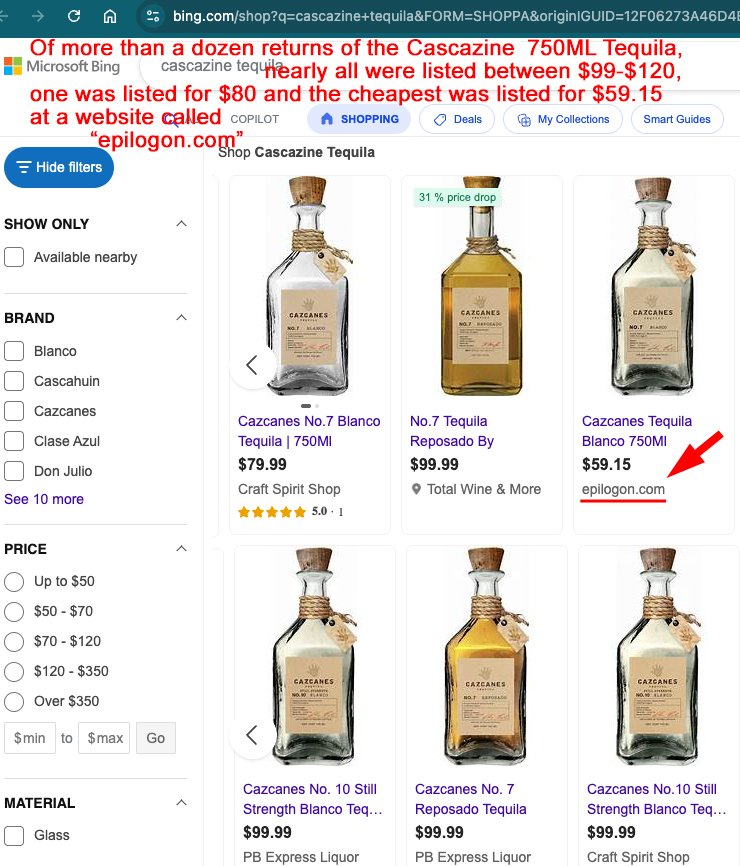
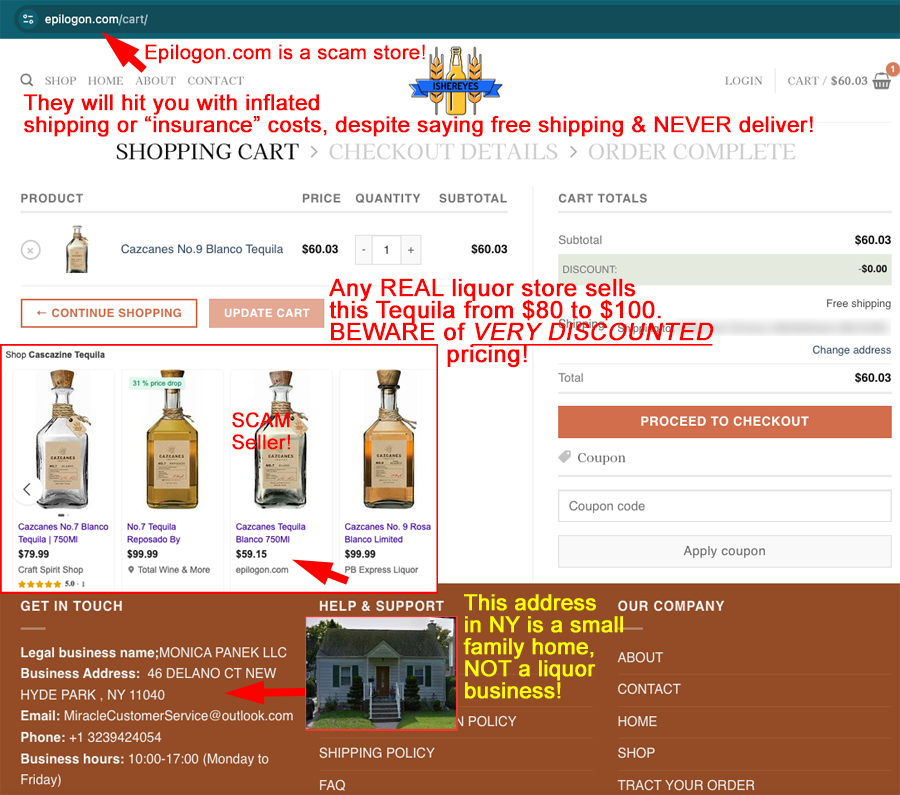
Since this heavily discounted liquor, 40 – 50% lower than nearly all of its peers, was so prominently displayed by Bing’s search engine, what could be wrong? David clicked the link to visit Epilogon.com. And he immediately noticed that a few things about this epic website seemed a bit off. For example, the price had been listed on Bing as $59.15 but when he arrived on the web page and added this item to his shopping cart, the price was listed as $60.03 for no particular reason. At the bottom of each webpage, the “Legal Business Name” was listed as MONIC PANEK LLC and an oddball email address was shown as MiracleCustomerService@outlook.com rather than an email associated with the website domain, or the business name. When we then looked up their listed business address of 46 Delan Ct., New Hyde Park, NY, we discovered a small single family home and NOT any type of liquor business or warehouse! And then perhaps most bizarre, a search for the company phone number, 323-942-4054, turns up two posts on the BBB.org’s Scamtracker website on May 23 and October 17 of last year, as well as other scam-related websites including a post on Scampulse.com about scam pet supplies last September. In each case, losses appeared to be small, about $60 – $100.
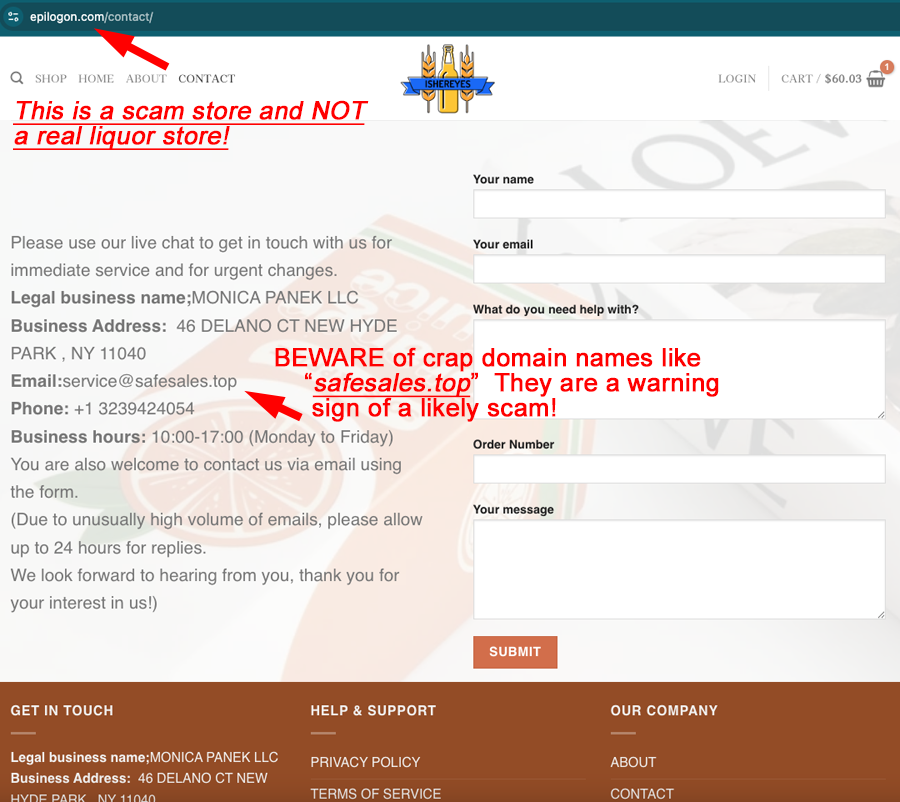
By this time, David knew this site was a fraud and further investigated by visiting the Contact webpage at the epilogon.com online liquor store. He was not surprised to find a new email address listed there that uses a “crap” domain named SafeSales[.]top. This domain was registered on June 29, 2024 by someone in Hong Kong. Oddly, it turns out that epilogon.com was actually registered way back in 2008. However, though the WayBackMachine Internet Archive shows 19 screen captures from this website, there is no website content visible or the archive is so old that it doesn’t have permission to visit this website, on 18 of these 19 screen captures. ….Until January of 2025! That’s when this domain shows up as an online liquor store.
David’s tequila was clearly not going to be shipped from that small house in New Hyde Park, New York! So where was it coming from? That is, of course, the fraud! It wouldn’t be shipped at all because this business doesn’t exist. Also, based on other similar scam websites, we strongly suspect that his low cost tequila would have also included additional charges like a hefty insurance charge, but only after David paid for his initial order. These bogus charges typically get added on to a low cost bottle after the initial payment is made. Interestingly, the “About Us” page at this scammer’s website twice refers to themselves as “stadthaeuser” (using a lower case s). What also supports our belief that this website is 100% a fraud is the fact that a search for the “Legal Business Name” of Monika Panek LLC turns up this reference of another scam liquor store website at Scamminder.com. But in this case, the scam liquor website is called Cybersecco[.]com. This liquor store was rated 35/100 last September, 2024 by Scamminder’s AI. And the final nail into this coffin of fraud is that we discovered someone had posted (on March 31) on Scampulse.com that they were cheated out of $75 for the purchase of a $65 bottle of liquor from Epilogon.com.
Despite Bing’s disappointing ability to keep scam sites from displaying so prominently in David’s search results, he eventually found a delicious and reasonably affordable tequila. And then, completely unrelated, a week later we received a request for help from a businessman in South Korea. The man asked us if, in our opinion, we thought fastlinemsc.com was a real or fake shipping company. It took us no time at all to find evidence that this shipping company was absolutely a fraud, but we wanted to know why he was asking. Typically, fake shipping websites are the tail end of another fraud narrative. Sure enough, he had a story to tell us….
The owner of this small South Korean business told us that they needed to order a large amount of food products and went onto Google to search for them. He quickly found a company that placed high on Google’s list of returns and seemed affordable. It was called BLL Food & Drinks GMBH, using the website bllfooddrinksgmbh.com. On their “About Us” page, BLL Food & Drinks GMBH says “We are a customer-focused business, and our employees are just like our products—built quickly. In a quick-moving, dynamic market where change is the only constant, our expanding Trading competes.” They say their main office is located at Unterdorf 215, 5753 Saalbach Salzburg, Austria. The S. Korean business owner told us that he purchased five metric tons of Sesame Seeds as a trial order from BLL Food & Drinks GMBH company. But he added that he thought it was odd that this wholesale food company required him to use either Westernunion or MoneyGram for the payment transaction. He was not able to make a direct bank transfer or pay by a credit card, both of which are serious red flags! He paid the bill and was told that his product would be shipped to him by Fast Line MSC Shipping Logistics, who uses the website fastlinemsc.com. This shipping company states that it is headquartered in Germany and their documentation shows their address as WANHEIMER STR.90, 40468 DUSSELDORF GERMANY. But our search of this address shows that a different shipping business is located there in Germany, and called Ceva Logistics! (The Ceva Logistics domain was registered long ago in 2006). Also, we could NOT find any business called BLL Food & Drinks GMBH at the Salzburg, Austria address either!
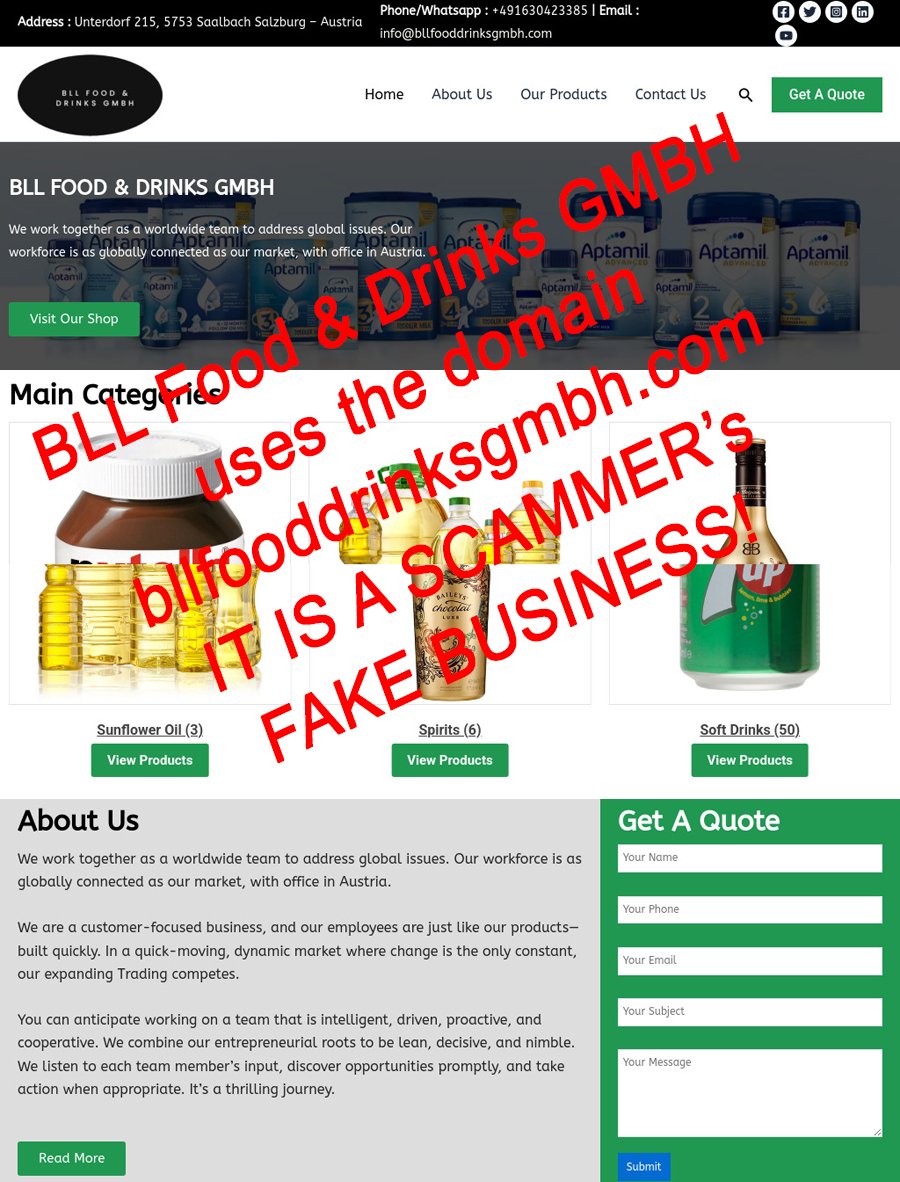
Experience has taught us that when someone is defrauded by a shipping company, it typically means that the other company or person moving materials through the fake shipping company is actually also a fraud! As you might expect, BLL Food & Drinks GMBH is a scammer’s website and used to trick buyers. However, unlike any other scam we’ve investigated, this fraud pretends to be an agricultural wholesaler and targets businesses! When we conducted a search for information about this company, we were surprised to find that this fake company was advertising on Alibaba.com. But, a website called Global Sources also posted a warning about this company. (See screenshot below.) (Globalsources.com is an online B2B marketplace and sourcing platform that connects buyers and suppliers worldwide, according to Google.)
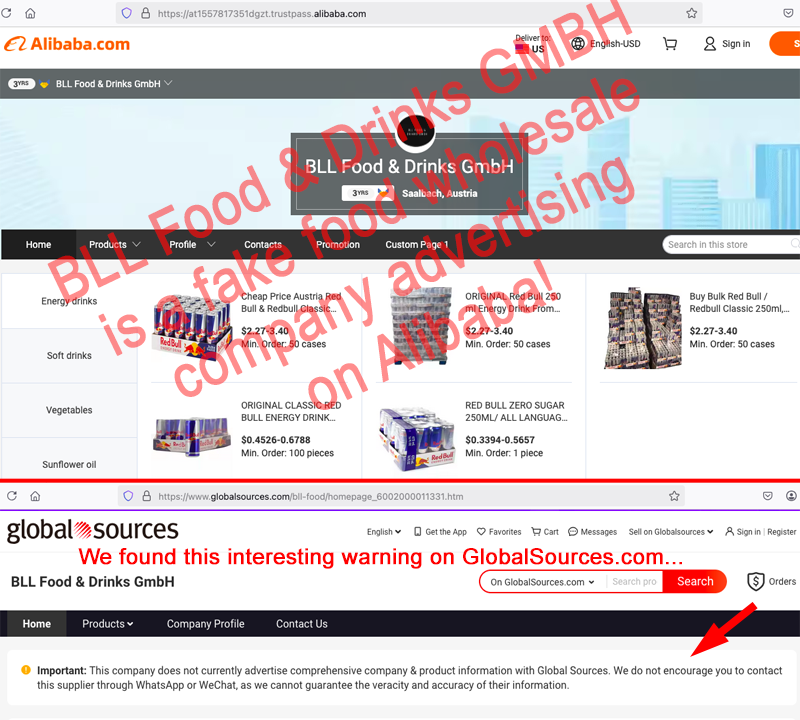
In fact, there are many warning signs on the internet about this bogus wholesale company if you take the time to look. For example…
- Scam-Detector gives bllfooddrinksgmbh.com a very low trust score, indicating it is risky!
- ScamAdviser.com lists bllfooddrinksgmbh.com as suspicious.
- Scamminder.com gives bllfooddrinksgmbh.com a very low trust score.
- If you conduct a Google search for reviews of BLL Food & Drinks GMBH you’ll find none! Moreover, you may also discover that this supposed wholesale agricultural business claims to sell a crazy wide variety of products including sheet metal and toothpaste.
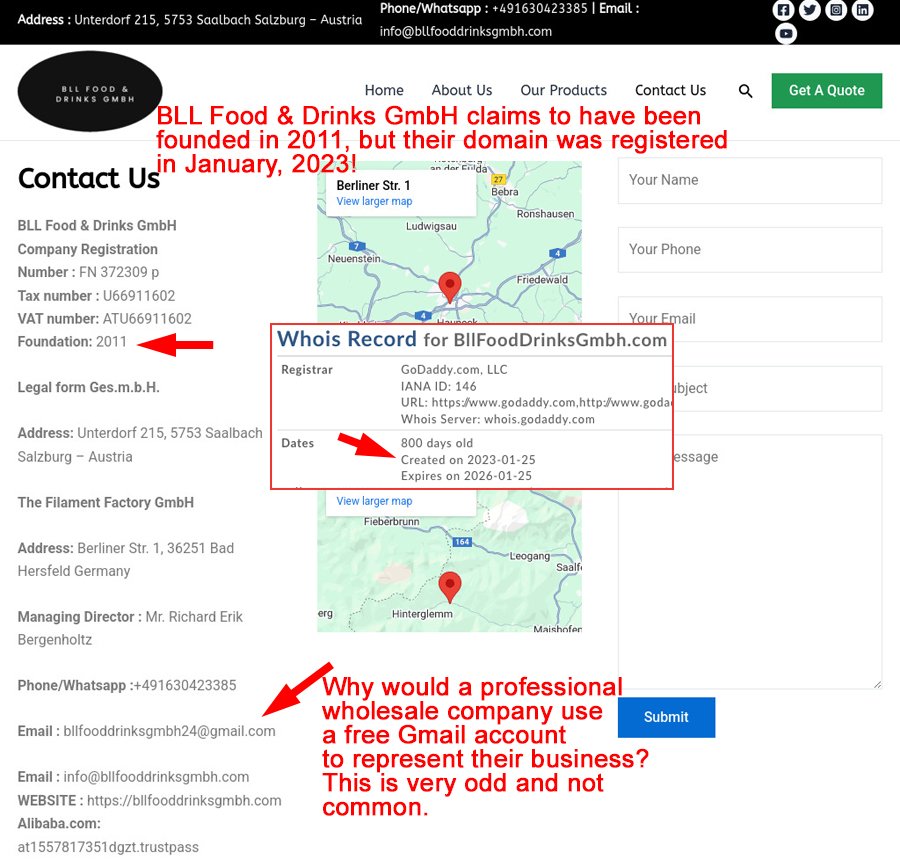
If you look at their Contact Us webpage at bllfooddrinksgmbh.com, you’ll see that it says they were founded in 2011. Then why is it that their domain was registered in January, 2023? Also, they show a free Gmail address on their Contact page which is very odd for a professional company to do.
You may recall that the South Korean businessman didn’t realize that he was being scammed until after he paid the shipping company Fast Line MSC Shipping Logistics to ship the 5 metric tons of seeds! And he had already purchased these seeds from BLL Food & Drinks GMBH. He told us “After they received all of money from us, they do not receive our call and never reply from email.” The shipping company was part of this fraud! It turns out that this bogus shipping company was already listed amongst the hundreds of fake shipping companies on our website at: https://www.thedailyscam.com/fake-shipping-companies/
(NOTE: If you visit our list of fake shipping companies, use Control-F (on a PC) or Command-F (on a Mac) and enter fastlinemsc to jump down to that listing.)
This financial loss could have been avoided if the businessman had done a bit of investigating before trusting these new companies. However, and not uncommon, he also told us that he is “old” and not terribly skilled at using the Internet.
It’s important to circle back to the most important point of these examples of fraud. The whole point of this article was to bring attention to the fact that online fraud is so much easier for scammers because search engines, like Google and Bing, don’t provide ANY built-in, automatic resources to identify fraud or suspicious websites as a part of their search results! This is NOT acceptable in today’s age of explosive online fraud! And, with their development of AI tools, this should be exceptionally easy to incorporate into search results! (Think of Google’s AI results that often appear at the top of page 1 results.) For example….
- Search engines should automatically look up the age and other information about a website domain to show to people. Younger domains should immediately be flagged as suspicious. AI should crawl a website and report inconsistencies with a company’s founding date and domain age, such as “founded in 2011” but registered in 2024!
- Search engines should automatically include score reports from several anti-scam tools such as those we’ve mentioned above! They should offer a warning in their Google listing if their own AI tools also finds a website domain name is listed on a site reporting fraud, such as on websites like ours, or Scamtracker at BBB.org.
- Search engines should automatically include low trust ratings from sites like Yelp, Trustpilot, BBB.org, and of course Google reviews. AND, if there are no reviews at all found by their AI tools, that should be reported as well since it could be a warning sign, especially if a website is more than a year old!
It is a completely new and dangerous Internet era as a result of the massive worldwide explosion of online fraud! We must demand that the companies that produce everyday tools used to connect with and search the internet step up and provide better protections for consumers around the world!
REMINDER: There are many more fake online businesses that turn up in a Google or Bing search. Scamadviser recently posted an article about anoth fake store, selling products at absurdly cheap prices…
https://www.scamadviser.com/articles/is-cheapeststoreru-legit-or-a-scam
About pricing, if it seems too good to be true, it is!
Approved Advertisement
Factual Information in Times of Uncertainty, Social Media Posts about Voting Rights & More!
To say “we live in uncertain times” almost sounds cliche today. But I am certain that many Americans, and citizens in other countries, think the world today feels less safe, predictable and reliable than it did even 10-15 years ago. The current Tariff war from the United States government and its impact on global markets, the literal war in Ukraine by Russia, along with it’s alleged proxy targets across Europe, severe storms from climate change, as well as the veritable deluge of misinformation/disinformation campaigns in social media and elsewhere, all contribute to this feeling of unease, uncertainty and insecurity. It’s sometimes hard to know where to look for the truth about what is happening around us. As the Content Director for TheDailyScam.com, a blog focused on exposing online fraud, dilineating truth from fiction online is extremely important. Many times, I find myself reading something and wondering “is this accurate? Is this true?” Or am I being manipulated by bias, misinformation or a targeted disinformation campaign? A recent example came up last week when one of my friends reposted something on Facebook that appears to have originated by a group called The Guardians of Democracy. It said, in the United States “8 in 10 married women have changed their surname which means they don’t have a birth certificate that matches their current legal name. 69 million women have to get new IDs to vote under the SAVE Act. The GOP is trying to silence women across the country.” I personally found this post to be very concerning. The SAVE Act appears to have originated from very Conservative members of our Congress as a result of unproven theories that voting in the United States is littered with fraud. However, other than a handful of proven cases of voter fraud, there has never been any factual basis with evidence supporting any of these claims, going back years including the 2020 election.
When I first saw this social media post on April 11 about the SAVE Act, it resonated with my understanding of the very right-leaning push to restrict elections across the United States. But again, I wondered, is this post accurate? It turns out that this post is true in part, BUT it is also misleading! I then read this outstanding article on FactCheck.org titled Will SAVE Act Prevent Married Women from Registering to Vote? (Published February, 28, 2025). According to the FactCheck article, although some women will absolutely be impacted negatively by the SAVE Act as it is currently written, an overwhelming majority will not because they already have other acceptable forms of identification that are allowed by the SAVE Act, such as a US Passport, a government-issued photo ID, or a REAL ID Driver’s License. (A “REAL ID” is required nationally by May 7 for anyone wishing to fly domestically on all commercial aircraft.) Also, in order to vote, veterans and members of the US Military can show a US Military ID but only if it is shown with a military record of service that also shows the United States as the applicant’s birthplace. And, according to the FactCheck article, there are many other ways that people can prove citizenship that vary by State. My point here is that yes, the SAVE Act will likely make it very difficult for some women to vote due to unfair demands and restrictions! However, it likely isn’t anywhere near the 69 million voters as suggested in the Facebook post. For example, it is reasonable to believe that many of these American women will have either a US Passport or a REAL ID for their Driver’s License. (According to 2022 Statistic Reports, there were about 68.45 million married women living in the United States at that time. And according to other credible sources, including our own government, by early 2025 about 45-50% of Americans had valid US Passports. So it is reasonable to assume that many of the currently married 69 million American women have valid US passports! And, as previously stated, a driver’s license that is also a REAL ID is very likely held by millions of married woman across the US, especially with the May 7th deadline looming for those who wish to use domestic air travel.)
Regardless of the actual number, the fact that any American citizen, might lose her or his right to vote because of a poorly written, possibly biased, SAVE Act is wrong. And this is especially true if this right is lost because a woman simply chose to follow traditional marriage naming conventions! Fortunately, the SAVE Act has not yet been voted into law. And the outstanding article on Factcheck.org can help women understand if they will still be able to vote should it become law, and what steps they must take to protect their voting rights. Given how important voting rights are to our American Democracy, we encourage you to share this information with friends and family. Fraud refers to intentionally deceiving someone. Though it is usually carried out for someone else’s financial gain, all too often it is also carried out as a way to falsely manipulate others, sway their way of thinking, or to diminish their rights and abilities.
Today, more than ever, it is critically important to check facts before you believe information that may have consequences and implications in your lives! I have several important recommendations to help people navigate through all the noise and distractions. I have been visiting these sites for years and have found them to be extremely truthful and reliable, as already noted in my evaluation of the SAVE Act Facebook post. These websites, listed below, have helped me to see through online bias, misinformation and fraud. When you see news or information that seems biased, or feels unimaginable, or that is spreading across social media from unknown sources, STOP for a moment! Before you believe what you see, or pass it on to others, consider using these resources to help you understand if what you are reading/seeing is true or if it is heavily biased, left or right:
- FactCheck.org – An outstanding website from the Annenberg Public Policy Center at UPENN.
Two recent articles/areas of their website, for example, are….
“How to Combat Misinformation” (published April 2, 2025)
“Debunking Viral Claims” on Social Media such as Facebook (with links to multiple articles)
- MediaBiasFactCheck.com – An outstanding service describing themselves as “an independent website that has promoted awareness of media bias and misinformation by rating the bias, factual accuracy, and credibility of media sources, large and small.” This excellent service, for example, provides a list of many dozens of news sites that are rated very high for factual, least biased reporting of events, along with how/why they were given this designation! Their methodology and analysis is also outstanding. For example, it probably wouldn’t surprise our readers that MediaBiasFactCheck rates the MSNBC as “MIXED” for factual reporting and also a bias rating that is very left of center. Or that Fox News is rated as “MIXED” for factual reporting and a bias rating that is very right of center. By contrast, news services rated as least biased, and very high factual reporting can be found listed on their “Center” page and include C-Span, Center for Responsive Politics (via their website OpenSecrets.org) and USAFacts.org.
- An outstanding resource for schools, teachers & students is the News Literacy Project at https://newslit.org/educators/resources/in-brief-news-media-bias/ Their Checkology Project is a great tool to be used in Middle and High School teaching! Also, their RumorGuard.org site offers a fascinating look at disinformation manipulation in relevant newsworthy information!
- AllSides.com is another excellent resource to help you understand bias, truth from lies and includes a media bias section.
(NOTE: A valuable search method you can use to search for specific content on these websites above is to use the “Site:” command in Google. This short YouTube video explains how to do this.)
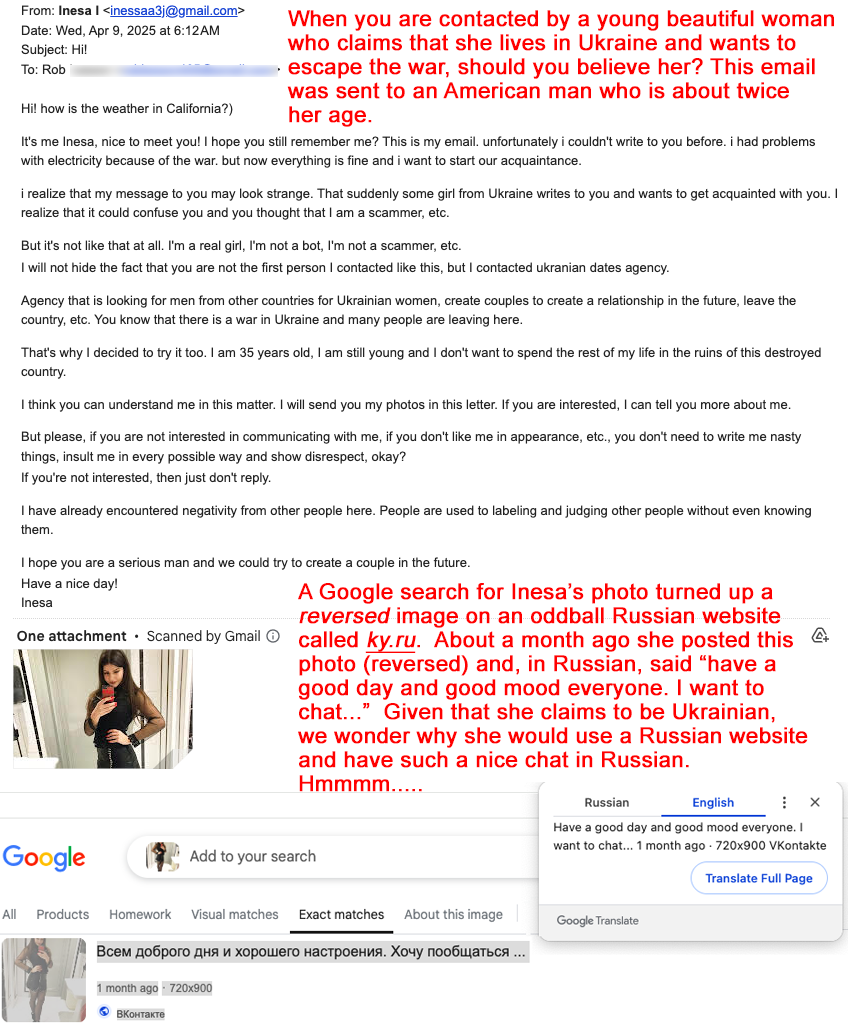
Our friend Rob continues to get emails from beautiful women from Eastern Europe. We can’t help but notice that many (most?) of these women who are randomly looking for love online claim to be from Ukraine. Given the horrible tragedy of Russia’s war against Ukraine, can you blame them? But when we discovered that a supposedly Ukrainian woman, named Inesa, also recently posted to a text thread on a Russian website, in Russian, we had to wonder if she was lying to Rob about her home country! Russia has brutallly and unfairly destroyed so much of Ukraine, killing thousands of innocent women, children and men. Why would a young, beautiful Ukranian woman feel OK about chatting on a Russian website? It certainly feels odd to us, just like her willingness to reach out to a man who could be her father’s age….
Other worthwhile articles about online fraud recently include…
Malwarebytes recently published some interesting articles that may interest our readers. They include…
Tax fraud targeting Americans typically explodes at this time of the year. This year is no different! Check out this recent example of a tax scam meant to phish your login credentials…
Phishermen are increasingly using QR codes as their means to target victims:
Parents of young children sometimes use tracking services to keep tabs on where their kids are. But what if these tracking services messed up and start showing you random photos and locations of other children? How would that make you feel about the data associated with your own children? Apparently, this is alleged to have happened to a tracking service called SyncUp from T-Mobile:
Unfortunately, people’s official IDs are sometimes stolen or lost. And sometimes people are tricked into giving copies of their IDs to fraudsters around the globe. But could you ever guess that a stolen/missing ID could result in ruining a man’s life because the thief added a criminal record to the victim’s life? Check out this crazy story about a young man impacted by this event….
Oh, the cleverness of scammers! Would you believe that some have tricked people to click a link while in a Zoom call that results in malware being installed on their computers? Check out this article on Scamadviser…
https://www.scamadviser.com/articles/hackers-are-hijacking-zoom-calls-dont-click-that-link
Could you imagine that foreigners with the proper authority to live and work in the UK are also scamming their own citizens in their home countries through job scams? BBC Reporters even caught an African Doctor running this scam while working in the UK! Visit: https://www.bbc.com/news/articles/c1en4dx7yn9o
We Appreciate Your Order, Suspicious Signin, & Docusign
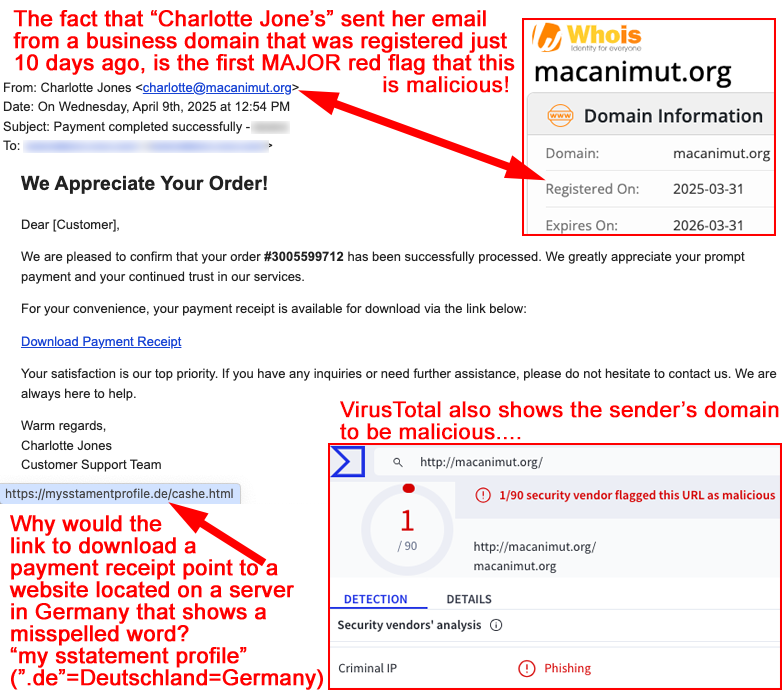
Our first smelly phish this week was sent recently to an accountant. This email doesn’t even inform the person about WHAT was ordered! But it came from someone named Charlotte Jones at her domain macanimut[.]org and the link in this clickbait points to a perfectly and sensibly named website called MySStamentProfile[.]de. What, you say? Is that short for “my statement profile?” First of all, that misspelled website was registered just 10 days ago and in Germany! (“.de” = Deutschland = Germany). Sadly, Charlotte’s domain, macanimut[.]org has already been identified as a phishing fraud. Delete, but we appreciate your effort.
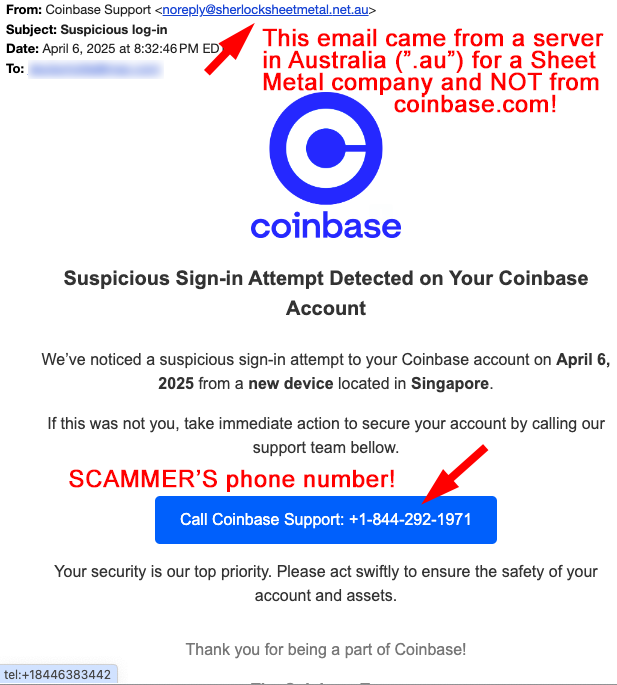
In case you didn’t know, Coinbase is a cryptocurrency exchange. This next rotten phish clearly wants you to believe it was sent by Coinbase Support but that name was simply entered into the text field of the FROM address. This rotten phish was sent from a sheet metal company’s server in Australia! Not from coinbase.com. So don’t bother calling them at 844-292-1971 because it’s just another scammer phone number! HOWEVER, if you care to pull out your noise-canceling headphones and Airhorn can, please call them often!
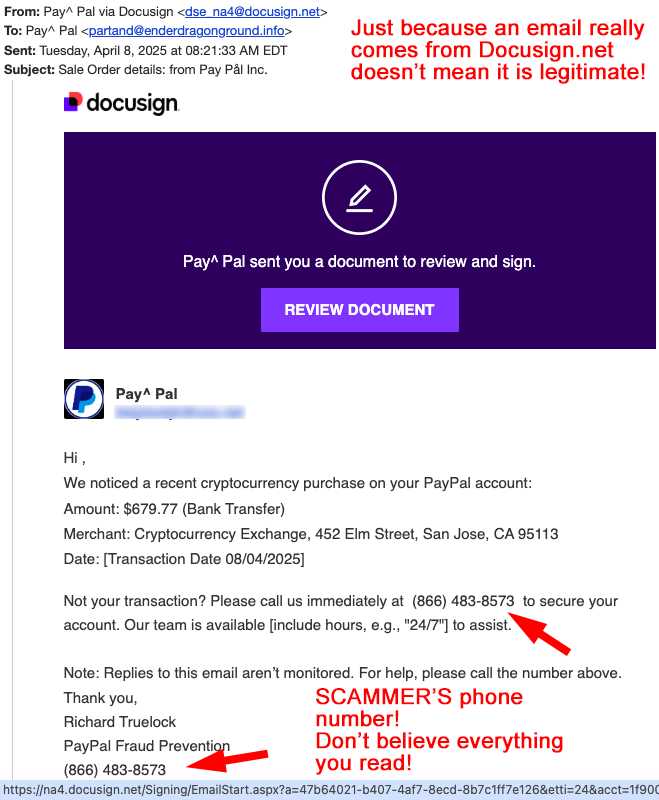
Yes, this third smelly phish did actually come from Docusign.net, a legitimate company website. But that doesn’t make the content legitimate! Scammers simply created a fake Docusign account and then created a fake document and sent out emails by the thousands using bogus information in the email notes field! You didn’t have a recent cryptocurrency purchase on your Paypal account. But you DID have a scammer try to trick you into calling them at 866-483-8573. Do you have your Airhorn can ready?
Remember to report your smelly phish to us and Google!
https://safebrowsing.google.com/safebrowsing/report_phish/
Luxury Watches & Your Netflix Membership Has Expired
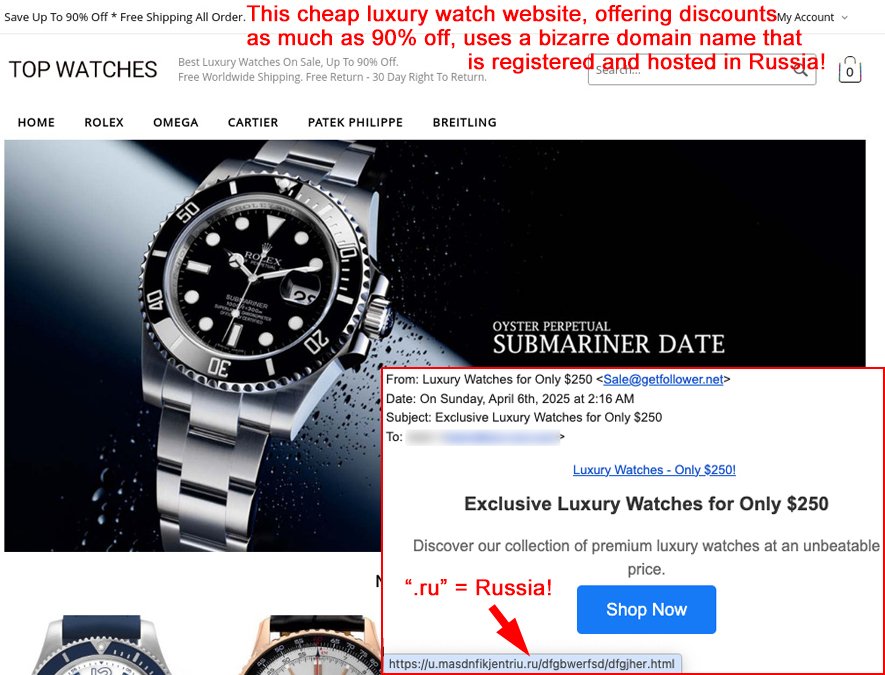
Thinking of Russia just warms the heart, doesn’t it? One of our readers shared this awesome email and website with us about “Luxury Watches for Only $250!” Guess where this website is located? That’s right, Russia! The website domain name is such a crazy, nonsensical mix of letters that we can’t begin to imagine how to pronounce it! Maybe it’s time for some Russian language lessons? According to this WHOIS record, this crazy-name website was registered on August 28, 2024. With prices as much as 90% off, are we worried about anything going wrong about this great deal? Hell yes! VirusTotal shows multiple security services saying that this website is malicious!
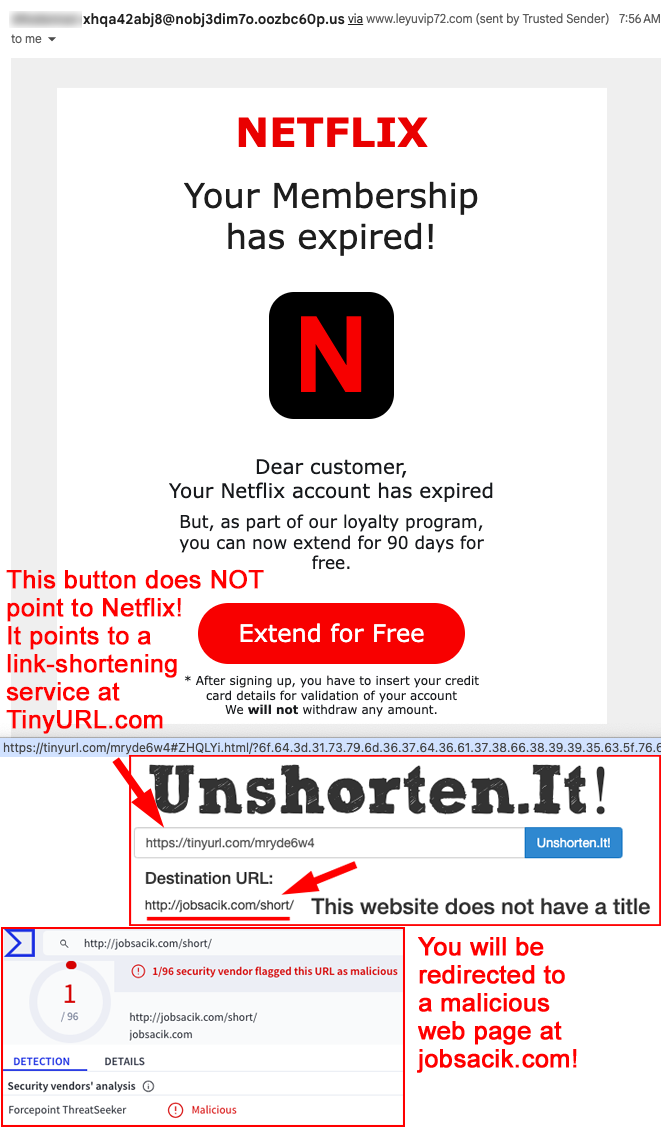
Oh no! Your Netflix membership has expired! How will we ever finish The Residence or The Long Island Serial Killer! **GASP** But before you click that link, we hope you’ll notice that this email didn’t come from netflix.com and the link certainly doesn’t point to it! In fact, the link points to a link-shortening service. (NOTE: Everything after the # symbol, including the “#” symbol itself, is not important and can be discarded if you wish to unshorten a link using tools like Unshorten.it or Urlex.org.) When we unshortened that link, we discovered that we’ll be redirected to a malicious website called jobsacik[.]com. LUNGE for the delete key!
New Document Shared with with you & New Incoming Voice Message
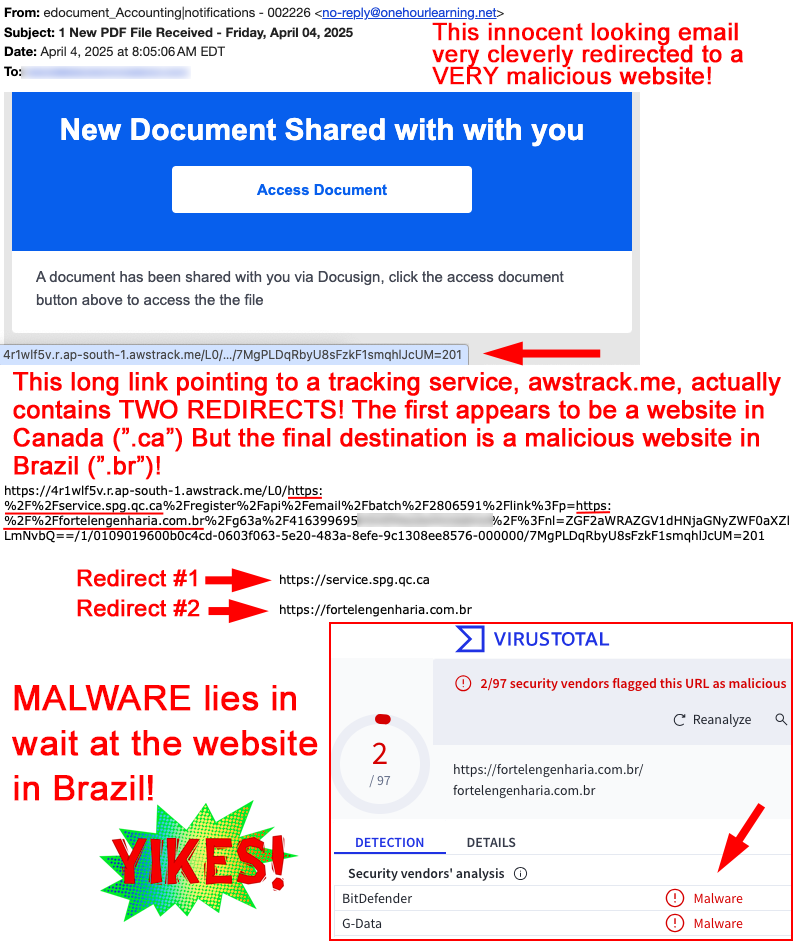
OK, we say it over and over….and it’s true! DETAILS MATTER! Check out this email sent to an accounting firm. In the big, bright, blue box it says “New Document Shared with with you.” And this email wants you to think it came from Docusign?? That’s that’s nonsense! However, what we DID find interesting about this very malicious clickbait is that the very looooooong link to “Access Document” actually contained, not one, but TWO redirects! To make it easier for you to see how redirects are built into some links, check out the screenshot below. If you see another “http” or “https” inside of a link (rather than at the start of a link), it means you’re going to be redirected to a different website than you think. In this link, you are first led to believe that you’ll be visiting the click-tracking service at awstrack[.}me. But that is followed by a redirect to a website in Canada called qc[.]ca. Except…SURPRISE, you’ll actually be redirected to a website in Brazil called fortelengenharia[.]com[.]br where malware eagerly waits for your arrival!
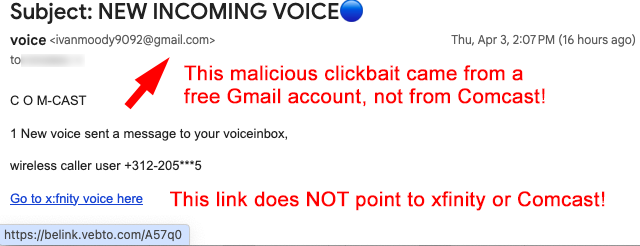
As if the above email wasn’t bad enough, here’s a lovely malicious clickbait that one of our readers sent us recently. It pretended to be a “new incoming voice” message from Comcast, spelled: C O M-CAST. Right. Like that spelling would never arouse suspicions that this tomfoolery could be malicious! Of course the link saying “Go to x:finity voice here” doesn’t point to either Xfinity or Comcast! Delete!
Apple Approval Notice, We Have an Opening, and DMV Unpaid Bill
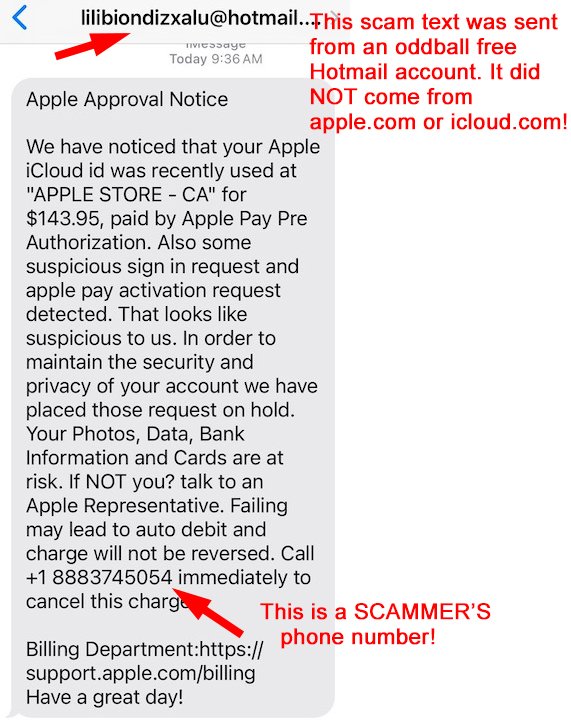
When an email from an oddball Hotmail account arrives in your text messages claiming to be an Apple Approval Notice, swipe left and hit DELETE! Trust us when we say that there is NO pre-authorized charge on any of your accounts! So, unless you have your Airhorn can and noise-cancelling headphones ready, DO NOT call these scammers at 888-374-5054.
Ahhhhhh……. Lily, Lily, Lily! You’re not listening to me! Why, oh why, won’t you read my responses to your recent job offer? And yet, over a five hour period you kept coming back with new texts to get my attention. Oh well. Your lack of interest in my responses simply means that I must block your phone number. Somehow, I’m sure I’ll hear from you again using another bogus number soon…

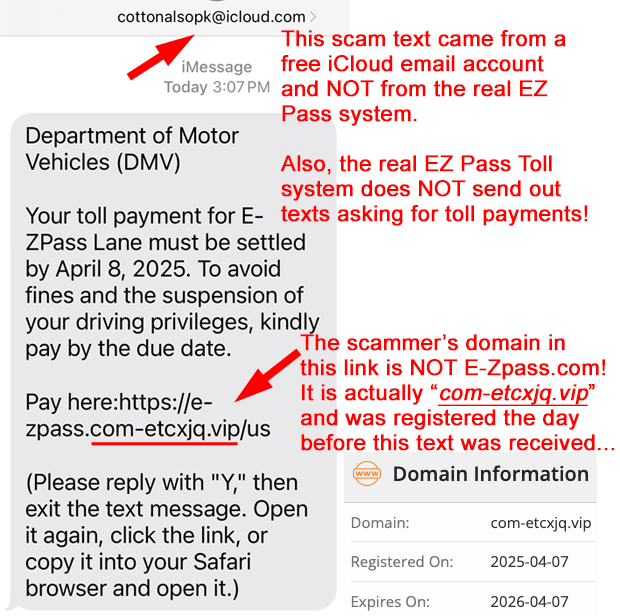
These bogus toll payment texts are driving everyone nuts! (**EYEROLL**) As if you didn’t already know, the real EZ Pass Toll Service will NEVER text you for something like this even if you had an unpaid fine! And certainly not from a random, bizarre iCloud email account!
Deeeeeeeleeeeeeete!
Until next week, surf safely!
Copyright © 2025 The Daily Scam. All rights reserved. You are receiving this email because you have subscribed to thedailyscam.com
Marblehead, MA 01945